
Chapter IIIPrimeval HistoryראשיתNoah
הרי אררט
The Mountains of Ararat
Noah and the Flood
Cheshvan 2106 BCE – Cheshvan 2105 BCEHebrew years 1656–1657traditionalחשון א׳תרנ״ו – חשון א׳תרנ״ז
וַתָּנַח הַתֵּבָה בַּחֹדֶשׁ הַשְּׁבִיעִי בְּשִׁבְעָה־עָשָׂר יוֹם לַחֹדֶשׁ עַל הָרֵי אֲרָרָט׃
“And the ark rested in the seventh month, on the seventeenth day of the month, upon the mountains of Ararat.”
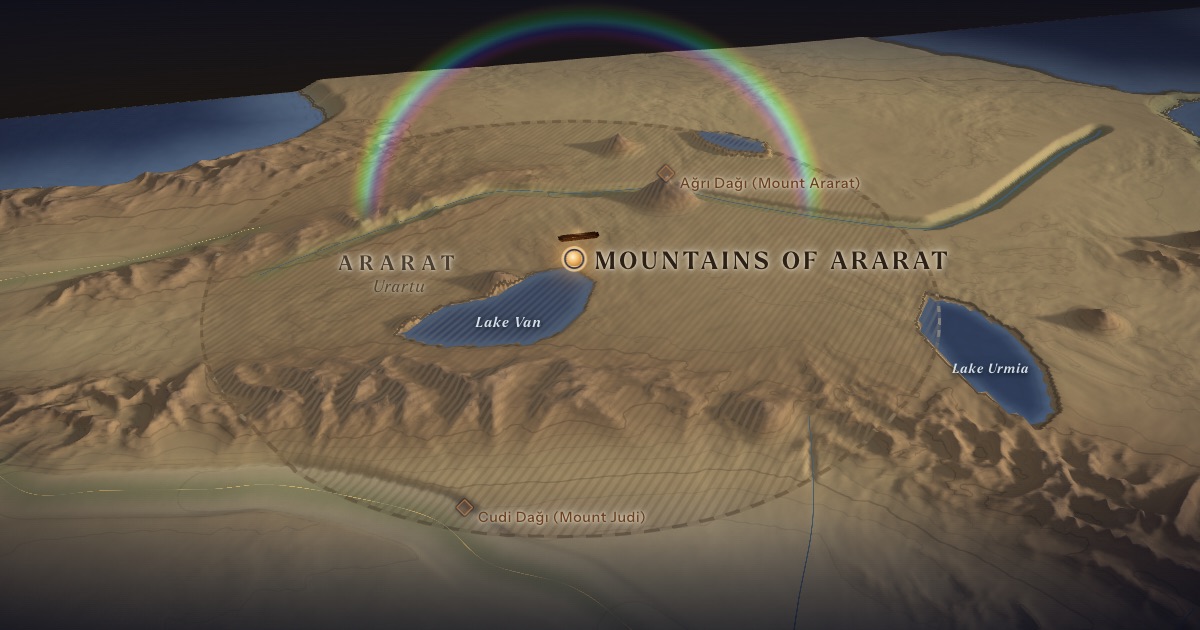
The Flood ends with the ark grounding on “the mountains of Ararat” — plural. In the Bible, Ararat is a land, not a single peak: the kingdom the Assyrians called Urartu, in the highlands around Lake Van. Which mountain was meant, the text does not say.
Location
The region is probable: “Ararat” corresponds to Urartu, the Armenian highlands. The mountain is unknown; the two main traditions point to different peaks.
- Mountains of Araratהָרֵי אֲרָרָט — Armenian Highlands (ancient Urartu)Probable identification 39.10° N, 43.40° EThe ark rests on “the mountains of Ararat” — the land of Urartu.
Proposed locations
- Ağrı Dağı (Mount Ararat)Tradition · Medieval Armenian and European traditionGreater Ararat, 5,137 m — the highest peak of the region.
- Cudi Dağı (Mount Judi)Tradition · Targum Onkelos (“Qardu”); Syriac Christian traditionRises above Cizre and the Tigris, south of Lake Van.
Chronology
Seder Olam dates the Flood to the Hebrew years 1656–1657 (2106–2105 BCE). Historians do not date a single universal flood.
The rain begins on 17 Cheshvan 1656, and Noah leaves the ark on 27 Cheshvan 1657 (Gen. 7:11, 8:14; Rashi).
Parsha
- Noachנח · Genesis 6:9
Biblical Narrative
Noah, “a righteous man, and wholehearted in his generations” (6:9), builds an ark at God’s command. The waters prevail for 150 days; in the seventh month the ark rests on the mountains of Ararat, and in the tenth month the tops of the mountains are seen (8:3–5). Noah sends out a raven and a dove, leaves the ark, builds an altar, and receives the covenant of the rainbow (8:6–9:17).
Geography
The Armenian highlands are the roof of the ancient Near East: a volcanic plateau mostly above 1,500 m, crowned by Greater Ararat (5,137 m). From here the Tigris and Euphrates descend toward Mesopotamia. Elsewhere in the Bible, “the land of Ararat” is where Sennacherib’s sons flee after murdering him (2 Kgs 19:37), and Jeremiah names “the kingdoms of Ararat” among Babylon’s enemies (Jer. 51:27).
Historical Context
Flood stories are central to Mesopotamian literature. The Old Babylonian epic of Atrahasis and Tablet XI of the Epic of Gilgamesh both tell of a hero warned by a god, who builds a boat, saves animals, sends out birds and offers sacrifice. In Gilgamesh the boat lands on Mount Nimush, usually placed in the Zagros east of the Tigris.
Archaeology
Excavations at Ur, Kish and Shuruppak revealed thick flood deposits, but they belong to different periods and reflect local river floods rather than a single event. No verified remains of the ark have been found; claimed discoveries on Mount Ararat and elsewhere have not been accepted by archaeologists.
Jewish Tradition
Targum Onkelos renders Ararat as “the mountains of Qardu” — the Kurdish ranges south of Lake Van, where Syriac Christian tradition placed the landing, on Cudi Dağı above the Tigris. Josephus cites the Babylonian writer Berossus for a tradition placing the ark in the mountains of the Cordyaeans. The identification with the great volcano Ağrı Dağı, now called Mount Ararat, became widespread later, in medieval Armenian and European tradition.
Traditional and rabbinic interpretation — presented as tradition, not as archaeological evidence.
Identification
- What the text says
- “The mountains of Ararat” (Gen. 8:4) — a mountainous land, not a named peak. Other passages confirm Ararat as a northern country (2 Kgs 19:37; Jer. 51:27).
- Traditional identification
- Targum Onkelos: “mountains of Qardu.” Syriac Christian and some Jewish traditions: Cudi Dağı above Cizre. Medieval Armenian and European tradition: Ağrı Dağı (Mount Ararat).
- Scholarly proposals
- Scholars agree that Ararat corresponds to Urartu, the kingdom centred on Lake Van that flourished in the 9th–6th centuries BCE.
- What remains uncertain
- Which mountain, if any specific one, the text intends is unknown. Expeditions searching for the ark have produced no accepted evidence.
Sources
Hebrew Bible
- Genesis 6:9–9:17בראשית ו׳:ט׳–ט׳:י״ז
- 2 Kings 19:37מלכים ב י״ט:ל״ז
- Jeremiah 51:27ירמיהו נ״א:כ״ז
Verse numbers follow the Hebrew (Masoretic) text. Links open the text in Hebrew and English on Sefaria.
Jewish tradition & interpretation
Interpretive tradition — not archaeological evidence.
- Targum Onkelos, the classical Aramaic translation of the Torah (early first millennium CE). — on Gen. 8:4תרגום אונקלוס על בראשית ח׳:ד׳
- Seder Olam Rabbah, rabbinic chronography attributed to R. Yose ben Ḥalafta (2nd century CE). Basis of the traditional dates cited on this site, counted in Hebrew years from Creation.סדר עולם רבה
Ancient & late-antique witnesses
- Flavius Josephus, Jewish Antiquities (c. 93–94 CE), Loeb Classical Library (Harvard University Press). — 1.93
Modern scholarship
- A. R. George, The Babylonian Gilgamesh Epic: Introduction, Critical Edition and Cuneiform Texts, 2 vols. (Oxford: Oxford University Press, 2003). — Tablet XI
- W. G. Lambert and A. R. Millard, Atra-ḫasīs: The Babylonian Story of the Flood (Oxford: Clarendon Press, 1969).
- Paul E. Zimansky, Ecology and Empire: The Structure of the Urartian State (Chicago: Oriental Institute of the University of Chicago, 1985).
- Nahum M. Sarna, The JPS Torah Commentary: Genesis (Philadelphia: Jewish Publication Society, 1989).
Translation
- The Holy Scriptures According to the Masoretic Text (Philadelphia: Jewish Publication Society of America, 1917). Source of the short quotations on each card (public domain). Verse numbers follow the Hebrew text.