
Chapter XXVIPatriarchal AgeאבותJoseph
דתינה
Dothan
Sold into Egypt
1545 BCEHebrew year 2216traditionalב׳רט״ז
וְהִנֵּה אֹרְחַת יִשְׁמְעֵאלִים בָּאָה מִגִּלְעָד וּגְמַלֵּיהֶם נֹשְׂאִים נְכֹאת וּצְרִי וָלֹט הוֹלְכִים לְהוֹרִיד מִצְרָיְמָה׃
“and, behold, a caravan of Ishmaelites came from Gilead, with their camels bearing spicery and balm and ladanum, going to carry it down to Egypt.”
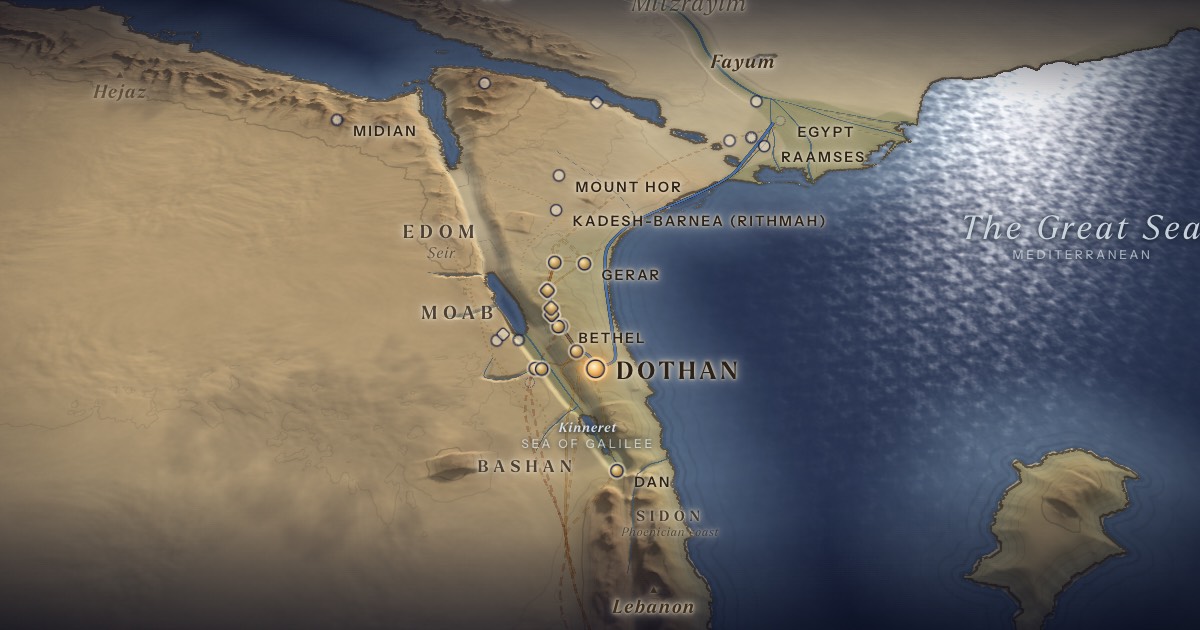
Jacob sends his favourite son, Joseph, from Hebron to see how his brothers fare with the flocks at Shechem. A stranger tells him they have moved on to Dothan. Seeing him coming in the coat his father gave him, the brothers cast him into a pit, then sell him to a caravan carrying spices from Gilead down to Egypt.
Location
Tel Dothan, in the northern Samarian hills — a probable identification.
- Dothanדֹּתָן — Tel DothanProbable identification 32.41° N, 35.24° EJoseph is cast into a pit and sold to a caravan.
The journey
Hebron → Shechem≈ 90 km
North along the ridge road. Roughly 2–3 days on foot.
Shechem → Dothan≈ 25 km
Roughly 1 day on foot.
Dothan → Egypt (the caravan)≈ 500 km
The coastal road to Egypt. Roughly 14–19 days at caravan pace.
Distances are estimates along plausible ancient corridors, not measured routes.
Chronology
Joseph is seventeen (Gen. 37:2).
Parsha
- Vayeshevוישב · Genesis 37:1
Biblical Narrative
Joseph dreams of sheaves and stars bowing to him (37:5–11). At Dothan the brothers plot to kill him; Reuben persuades them to throw him into a dry pit instead (37:18–24). Judah proposes selling him; Midianite traders draw him up, and he is sold to Ishmaelites for twenty shekels of silver (37:26–28). They dip his coat in goat’s blood; Jacob mourns (37:31–35).
Geography
Hebron to Dothan is about 110 km — a long way for a young man travelling alone. Dothan lies at the edge of a valley opening from the hills toward the Jezreel and the coastal plain, beside the route linking Gilead, across the Jordan, with the coastal road to Egypt. It is exactly where a caravan from Gilead would pass.
Historical Context
The caravan’s cargo — nekhot, tseri (balm) and lot (ladanum) — are aromatic resins prized in Egypt for medicine, incense and embalming. Kenneth Kitchen argues that twenty shekels matches slave prices of the early 2nd millennium BCE; others note that such prices varied widely over time.
Archaeology
Tel Dothan, excavated by Joseph P. Free (1953–1964), was a sizeable town from the Early Bronze Age through the Iron Age.
Jewish Tradition
Rashi (on Gen. 37:28) explains the mention of both Midianites and Ishmaelites by saying that Joseph was sold many times over — from the brothers to one caravan, and onward to others before reaching Egypt.
Traditional and rabbinic interpretation — presented as tradition, not as archaeological evidence.
Identification
- What the text says
- “Let us go to Dothan” (37:17).
- Traditional identification
- The name survives at Tell Dothan.
- Scholarly proposals
- Tel Dothan (probable).
- What remains uncertain
- The pit is unknown.
Sources
Hebrew Bible
- Genesis 37:1–36בראשית ל״ז:א׳–ל״ו
Verse numbers follow the Hebrew (Masoretic) text. Links open the text in Hebrew and English on Sefaria.
Jewish tradition & interpretation
Interpretive tradition — not archaeological evidence.
- Rashi (R. Shlomo Yitzḥaki, 1040–1105), Commentary on the Torah. — on Gen. 37:28רש״י על בראשית ל״ז:כ״ח
Modern scholarship
- Daniel M. Master et al., Dothan I: Remains from the Tell (1953–1964) (Winona Lake: Eisenbrauns, 2005).
- Kenneth A. Kitchen, On the Reliability of the Old Testament (Grand Rapids: Eerdmans, 2003).
- Donald B. Redford, A Study of the Biblical Story of Joseph (Genesis 37–50), VTSup 20 (Leiden: Brill, 1970).
- Nahum M. Sarna, The JPS Torah Commentary: Genesis (Philadelphia: Jewish Publication Society, 1989).
Atlases & reference works
- Ephraim Stern (ed.), The New Encyclopedia of Archaeological Excavations in the Holy Land, 4 vols. (Jerusalem: Israel Exploration Society & Carta, 1993); vol. 5 (2008). — s.v. “Dothan”
Translation
- The Holy Scriptures According to the Masoretic Text (Philadelphia: Jewish Publication Society of America, 1917). Source of the short quotations on each card (public domain). Verse numbers follow the Hebrew text.