
Chapter XPatriarchal AgeאבותAbraham
ככר הירדן
The Parting of the Ways
Lot chooses the plain of the Jordan
Not dated in the tradition
וַיִּשָּׂא־לוֹט אֶת־עֵינָיו וַיַּרְא אֶת־כָּל־כִּכַּר הַיַּרְדֵּן כִּי כֻלָּהּ מַשְׁקֶה לִפְנֵי שַׁחֵת ה׳ אֶת־סְדֹם וְאֶת־עֲמֹרָה כְּגַן־ה׳ כְּאֶרֶץ מִצְרַיִם
“And Lot lifted up his eyes, and beheld all the plain of the Jordan, that it was well watered every where, before the LORD destroyed Sodom and Gomorrah, like the garden of the LORD, like the land of Egypt.”
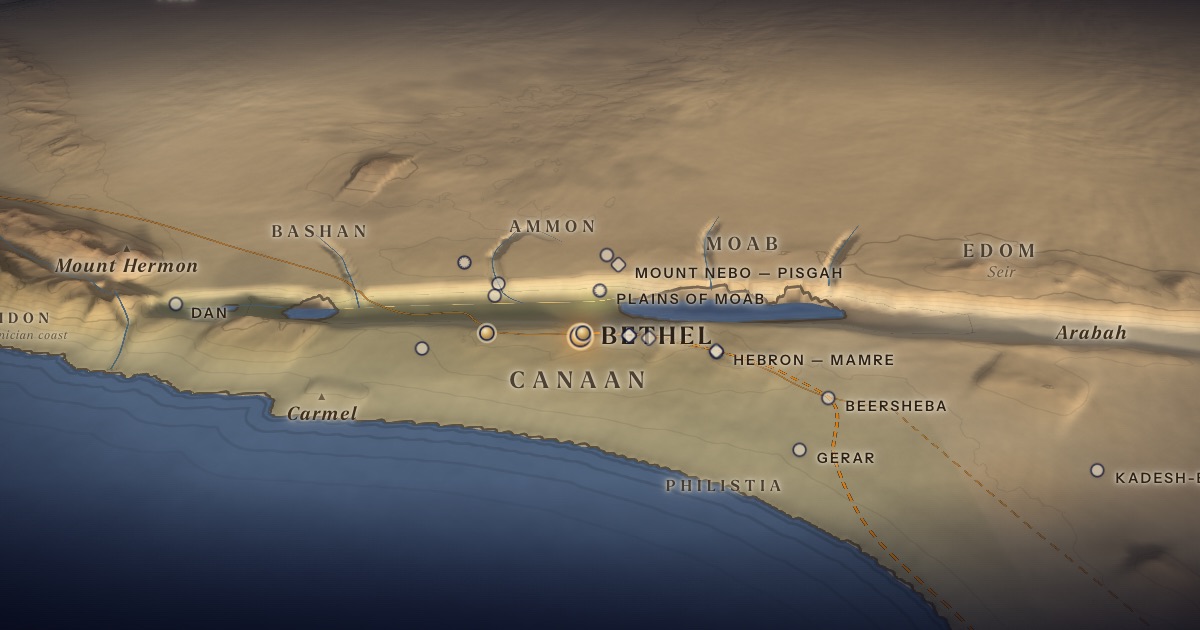
Back at the altar near Bethel, Abram and Lot have more flocks than the land can bear. Abram offers his nephew the choice. Lot looks east across the rift to the “plain of the Jordan” — well watered, “like the garden of the LORD” — and moves toward Sodom.
Location
The heights east of Bethel overlook the Jordan valley; the “kikkar” (round plain) of the Jordan is the valley floor north of the Dead Sea.
- Bethelבֵּית־אֵל — Beitin (most common identification)Probable identification 31.93° N, 35.24° EAn altar between Bethel and Ai; later, Jacob’s dream.
The journey
Egypt → the Negev → Bethel≈ 450 km
The coastal road, then up to the hill country. Roughly 23–38 days at the pace of flocks. Route conjectural.
Distances are estimates along plausible ancient corridors, not measured routes.
Chronology
After the return from Egypt and before Ishmael is born (1727 BCE, Hebrew year 2034; Gen. 16:16); the tradition gives it no year of its own.
Biblical Narrative
Abram, “very rich in cattle, in silver, and in gold,” returns from the Negev to Bethel (13:1–4). Strife breaks out between the herdsmen. Abram says: “if thou wilt take the left hand, then I will go to the right” (13:9). Lot chooses the plain of the Jordan and moves his tent as far as Sodom; Abram remains in Canaan (13:10–12).
Geography
From the ridge near Bethel (about 880 m) the land falls away more than 1,100 m to the Jordan valley, below sea level. The contrast Lot sees is real: the hill country depends on rain, while the valley’s springs — Jericho’s among them — support oases. The text adds that the plain was lush “before the LORD destroyed Sodom,” setting up the catastrophe to come.
Historical Context
Pastoralists and town-dwellers coexisted uneasily in Canaan; disputes over grazing and water are among the most common themes of ancient Near Eastern texts, from Mari to Genesis.
Jewish Tradition
Rashi (on Gen. 13:11) reads Lot’s journey miqedem (“eastward”) as a moral turn: Lot “removed himself from the Ancient One of the world,” choosing Sodom’s wealth.
Traditional and rabbinic interpretation — presented as tradition, not as archaeological evidence.
Identification
- What the text says
- Abram returns “unto the place of the altar” between Bethel and Ai (13:3–4); Lot chooses “all the plain (kikkar) of the Jordan” (13:10–11).
- Scholarly proposals
- The kikkar is usually understood as the round plain of the lower Jordan valley, north of the Dead Sea — a point central to the debate over Sodom’s location.
- What remains uncertain
- Whether the kikkar also included the southern Dead Sea basin is disputed.
Sources
Hebrew Bible
- Genesis 13:1–13בראשית י״ג:א׳–י״ג
Verse numbers follow the Hebrew (Masoretic) text. Links open the text in Hebrew and English on Sefaria.
Jewish tradition & interpretation
Interpretive tradition — not archaeological evidence.
- Rashi (R. Shlomo Yitzḥaki, 1040–1105), Commentary on the Torah. — on Gen. 13:11רש״י על בראשית י״ג:י״א
Modern scholarship
- Nahum M. Sarna, The JPS Torah Commentary: Genesis (Philadelphia: Jewish Publication Society, 1989).
Atlases & reference works
- Yohanan Aharoni, The Land of the Bible: A Historical Geography, rev. ed., trans. A. F. Rainey (Philadelphia: Westminster, 1979).
Translation
- The Holy Scriptures According to the Masoretic Text (Philadelphia: Jewish Publication Society of America, 1917). Source of the short quotations on each card (public domain). Verse numbers follow the Hebrew text.