
Chapter XXVIIEgyptמצריםJoseph
יוסף במצרים
Joseph in Egypt
From the pit to Pharaoh’s court
1545–1532 BCEHebrew years 2216–2229traditionalב׳רט״ז–ב׳רכ״ט
וַיֹּאמֶר פַּרְעֹה אֶל־יוֹסֵף רְאֵה נָתַתִּי אֹתְךָ עַל כָּל־אֶרֶץ מִצְרָיִם׃
“And Pharaoh said unto Joseph: ‘See, I have set thee over all the land of Egypt.’”
Sold to Potiphar, an officer of Pharaoh, Joseph rises, is falsely accused and imprisoned. He interprets the dreams of Pharaoh’s cupbearer and baker, and at last Pharaoh’s own: seven fat cows and seven lean — seven years of plenty, seven of famine. Pharaoh makes him vizier and gives him an Egyptian name and a wife: Asenath, daughter of the priest of On.
Location
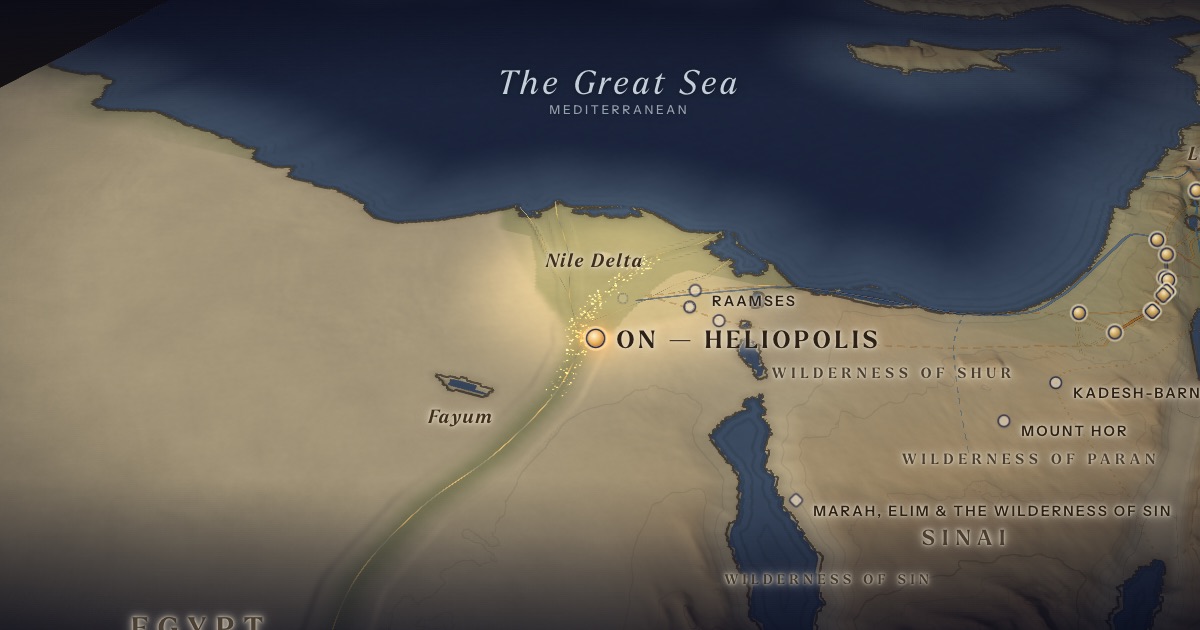
On is Heliopolis, the city of the sun god, now beneath north-eastern Cairo. The text does not locate the royal court.
- On — Heliopolisאֹן — Heliopolis (Matariya, Cairo)Probable identification 30.13° N, 31.31° EJoseph marries Asenath, daughter of the priest of On.
- Egyptמִצְרַיִם — Nile Valley and DeltaTextually identified 30.55° N, 31.35° EThe land of the Nile — refuge in famine, and later bondage.
Chronology
Seder Olam: Joseph stands before Pharaoh at thirty (Gen. 41:46) — the Hebrew year 2229.
Sold at seventeen (Gen. 37:2), he stands before Pharaoh at thirty.
Biblical Narrative
The LORD is with Joseph in Potiphar’s house (39:2–6); Potiphar’s wife accuses him and he is imprisoned (39:7–20). He interprets dreams in prison (ch. 40). Pharaoh dreams of cows coming up out of the river (41:1–7); Joseph advises storing a fifth of the harvest (41:34–36). Pharaoh names him Zaphenath-paneah and gives him Asenath (41:45).
Geography
Egypt is a river oasis: a ribbon of green rarely more than 20 km wide along the Nile, opening into the great fan of the Delta. Pharaoh’s dream — cows rising from the river — pictures cattle grazing the Nile’s marshy banks. Everything, from abundance to famine, depended on the height of the annual flood.
Historical Context
The Egyptian names in the story — Potiphar/Potiphera (“he whom Ra has given”), Asenath (“belonging to Neith”), Zaphenath-paneah — are genuinely Egyptian in form. Donald Redford argued that they are most typical of the 1st millennium BCE; Kenneth Kitchen and James Hoffmeier point to earlier parallels.
Archaeology
Heliopolis, among Egypt’s oldest religious centres, survives chiefly as a standing obelisk of Senusret I (20th century BCE) and fragments now being recovered by excavation. No Egyptian record mentions Joseph.
Jewish Tradition
The Talmud (Sotah 36b) and Midrash make Joseph’s refusal of Potiphar’s wife a model of self-mastery; he is remembered as Yosef ha-Tzaddik, “Joseph the Righteous.”
Traditional and rabbinic interpretation — presented as tradition, not as archaeological evidence.
Identification
- What the text says
- “On” (41:45, 50; 46:20); “Egypt” and “Pharaoh” throughout.
- Scholarly proposals
- On = Heliopolis (Egyptian Iunu) — probable.
- What remains uncertain
- The Pharaoh is unnamed, and the period of the story is debated.
Sources
Hebrew Bible
- Genesis 39:1–41:57בראשית ל״ט:א׳–מ״א:נ״ז
Verse numbers follow the Hebrew (Masoretic) text. Links open the text in Hebrew and English on Sefaria.
Jewish tradition & interpretation
Interpretive tradition — not archaeological evidence.
- Babylonian Talmud (Talmud Bavli), redacted c. 6th century CE. — Sotah 36bבבלי סוטה ל״ו ב
Modern scholarship
- Donald B. Redford, A Study of the Biblical Story of Joseph (Genesis 37–50), VTSup 20 (Leiden: Brill, 1970).
- Kenneth A. Kitchen, On the Reliability of the Old Testament (Grand Rapids: Eerdmans, 2003).
- James K. Hoffmeier, Israel in Egypt: The Evidence for the Authenticity of the Exodus Tradition (New York: Oxford University Press, 1997).
- Nahum M. Sarna, The JPS Torah Commentary: Genesis (Philadelphia: Jewish Publication Society, 1989).
Translation
- The Holy Scriptures According to the Masoretic Text (Philadelphia: Jewish Publication Society of America, 1917). Source of the short quotations on each card (public domain). Verse numbers follow the Hebrew text.