
Chapter XVIIIPatriarchal AgeאבותJacob
ויצא יעקב
Jacob Leaves Beersheba
A stolen blessing
1590 BCEHebrew year 2171traditionalב׳קע״א
וַיֵּצֵא יַעֲקֹב מִבְּאֵר שָׁבַע וַיֵּלֶךְ חָרָנָה׃
“And Jacob went out from Beer-sheba, and went toward Haran.”
Isaac, old and blind, means to bless Esau; Rebekah and Jacob contrive to take the blessing instead. Esau vows revenge. Rebekah sends Jacob to her brother Laban in Haran — and he sets out alone, with only a staff, on the road his grandfather’s servant once travelled with ten camels.
Location
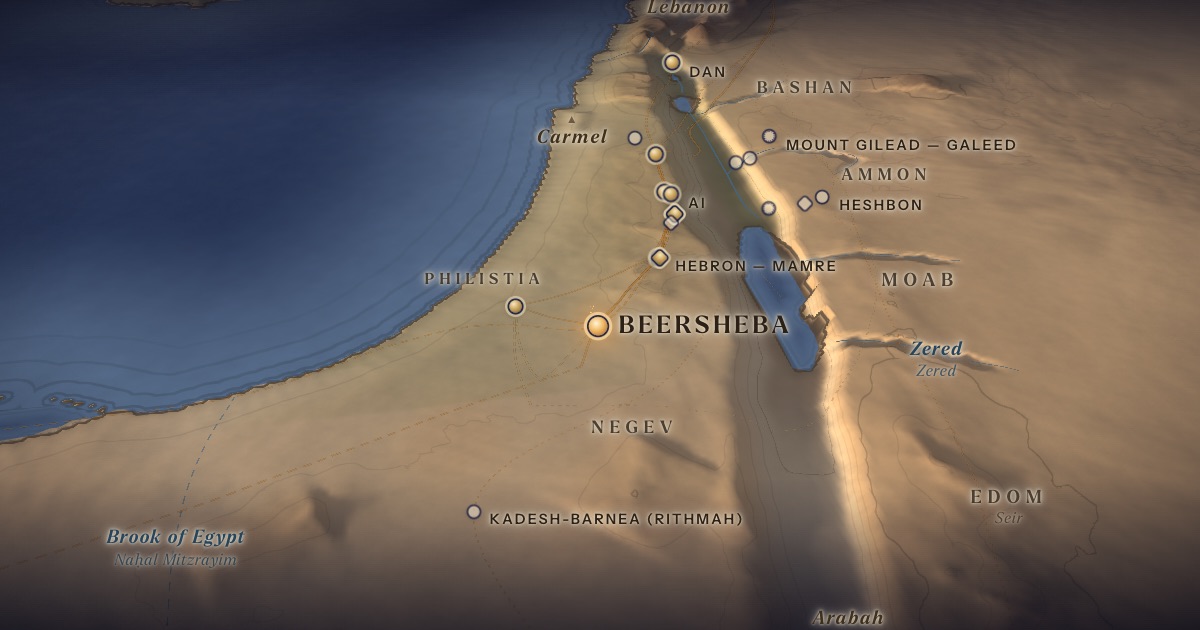
Beersheba, in the northern Negev.
- Beershebaבְּאֵר שָׁבַע — Tel Beersheba / Bir es-SebaʿProbable identification 31.25° N, 34.84° EThe well of the oath, and a tamarisk planted.
Chronology
Seder Olam: Jacob is sixty-three when he receives the blessing — the Hebrew year 2171.
He then spends fourteen years in the academy of Shem and Eber before going on to Haran (Megillah 17a; Rashi on Gen. 28:9).
Biblical Narrative
The twins struggle even in the womb (25:22–26). Esau, the hunter, sells his birthright for a bowl of lentil stew (25:29–34). Disguised in Esau’s garments, Jacob receives Isaac’s blessing (27:1–29). Esau plans to kill him after their father’s death; Rebekah sends Jacob to Laban, and Isaac charges him to take a wife from Paddan-aram (27:41–28:5).
Geography
Jacob’s road runs north along the hill-country ridge through Hebron and past Jerusalem toward Bethel, and on toward Damascus and the Euphrates. Unlike Abraham’s servant, he travels without camels or wealth: “with my staff I passed over this Jordan” (32:11 [Eng. 32:10]).
Historical Context
Genesis presents Esau as the ancestor of Edom (36:1–8), and the brothers’ rivalry mirrors the long, often hostile relationship between Israel and Edom in later centuries.
Jewish Tradition
Rashi (on Gen. 28:9, following Megillah 17a) calculates that Jacob spent fourteen years studying in the academy of Shem and Eber before continuing to Haran.
Traditional and rabbinic interpretation — presented as tradition, not as archaeological evidence.
Identification
- What the text says
- Jacob “went out from Beer-sheba, and went toward Haran” (28:10).
- Traditional identification
- Rabbinic chronology interposes fourteen years of study with Shem and Eber (Megillah 17a).
- Scholarly proposals
- Beersheba: see Abraham at Beersheba.
- What remains uncertain
- Whether the family’s encampment was at the later town or at wells nearby is unknown.
Sources
Hebrew Bible
- Genesis 25:19–34בראשית כ״ה:י״ט–ל״ד
- Genesis 27:1–28:10בראשית כ״ז:א׳–כ״ח:י׳
Verse numbers follow the Hebrew (Masoretic) text. Links open the text in Hebrew and English on Sefaria.
Jewish tradition & interpretation
Interpretive tradition — not archaeological evidence.
- Rashi (R. Shlomo Yitzḥaki, 1040–1105), Commentary on the Torah. — on Gen. 28:9רש״י על בראשית כ״ח:ט׳
- Babylonian Talmud (Talmud Bavli), redacted c. 6th century CE. — Megillah 17aבבלי מגילה י״ז א
Modern scholarship
- Nahum M. Sarna, The JPS Torah Commentary: Genesis (Philadelphia: Jewish Publication Society, 1989).
Translation
- The Holy Scriptures According to the Masoretic Text (Philadelphia: Jewish Publication Society of America, 1917). Source of the short quotations on each card (public domain). Verse numbers follow the Hebrew text.