
Chapter XIXPatriarchal AgeאבותJacob
סולם יעקב
Bethel — the Ladder
“Surely the LORD is in this place”
1576 BCEHebrew year 2185traditionalב׳קפ״ה
וַיַּחֲלֹם וְהִנֵּה סֻלָּם מֻצָּב אַרְצָה וְרֹאשׁוֹ מַגִּיעַ הַשָּׁמָיְמָה וְהִנֵּה מַלְאֲכֵי אֱלֹהִים עֹלִים וְיֹרְדִים בּוֹ׃
“And he dreamed, and behold a ladder set up on the earth, and the top of it reached to heaven; and behold the angels of God ascending and descending on it.”
At sunset Jacob stops for the night at a place called Luz, takes a stone for a pillow and dreams of a ladder with angels ascending and descending. God renews the promise made to Abraham. Jacob wakes: “Surely the LORD is in this place; and I knew it not.” He sets up the stone as a pillar and names the place Bethel — “house of God.”
Location
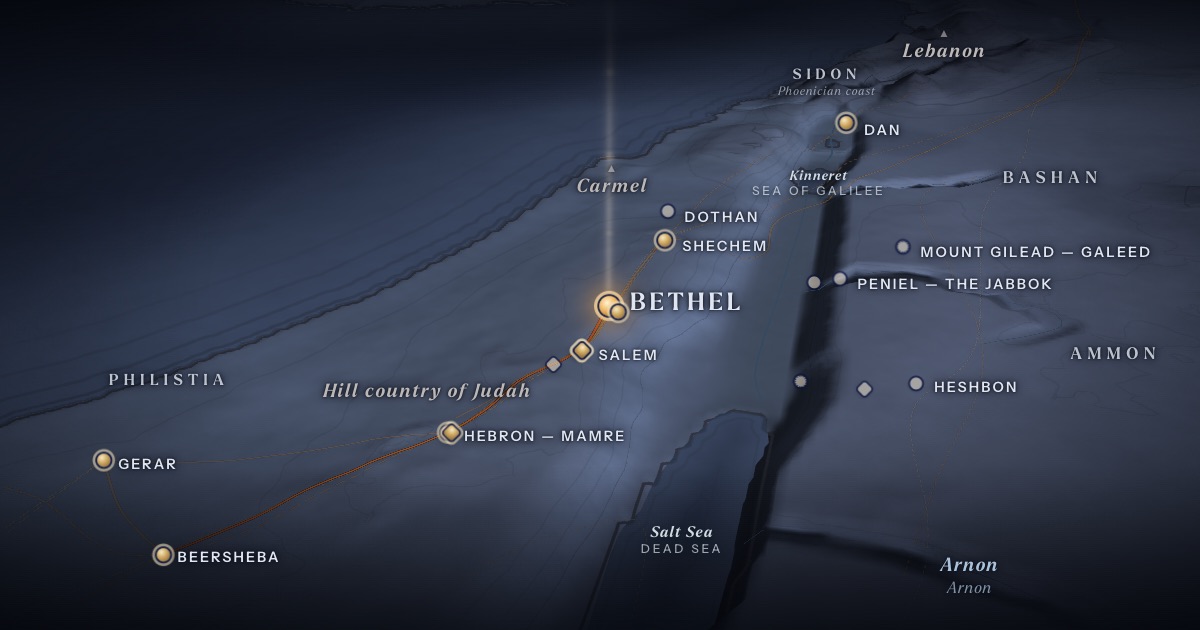
Bethel is commonly identified with Beitin, about 17 km north of Jerusalem.
- Bethelבֵּית־אֵל — Beitin (most common identification)Probable identification 31.93° N, 35.24° EAn altar between Bethel and Ai; later, Jacob’s dream.
The journey
Beersheba → Bethel≈ 90 km
North along the ridge road. Roughly 3–4 days on foot.
Distances are estimates along plausible ancient corridors, not measured routes.
Chronology
After fourteen years of study in the academy of Shem and Eber (Megillah 17a; Rashi on Gen. 28:9), Jacob, seventy-seven, sets out for Haran.
Parsha
- Vayetzeiויצא · Genesis 28:10
Biblical Narrative
“He lighted upon the place, and tarried there all night, because the sun was set” (28:11). God stands beside him and promises the land, countless descendants and protection: “I will not leave thee” (28:13–15). Jacob sets up the stone as a pillar, pours oil on it, renames Luz as Bethel and vows a tenth of all he gains (28:18–22).
Geography
Beersheba to Bethel is about 90 km along the ridge — three or four days on foot. Bethel stands on the watershed where the north–south road crosses routes east to Jericho and west to the coast: a natural halt for a traveller heading north.
Historical Context
Bethel later became a royal sanctuary of the northern kingdom of Israel, where Jeroboam set up a golden calf (1 Kgs 12:28–33) — which is why the prophets condemn it. The Jacob story gives the sanctuary its founding narrative.
Archaeology
Excavations at Beitin uncovered Middle Bronze Age fortifications and remains of later periods, though their interpretation has been revised (Finkelstein and Singer-Avitz 2009).
Jewish Tradition
Rashi (on Gen. 28:17) says that Mount Moriah was “uprooted and came here,” so that Jacob’s dream took place at the future Temple site; the Talmud speaks of the earth “contracting” for Jacob (Chullin 91b). The Midrash reads the angels as the guardian angels of the nations, rising and falling in turn (Leviticus Rabbah 29:2).
Traditional and rabbinic interpretation — presented as tradition, not as archaeological evidence.
Identification
- What the text says
- “He called the name of that place Beth-el, but the name of the city was Luz at the first” (28:19).
- Traditional identification
- Rashi: the dream took place on Mount Moriah, miraculously brought to Jacob — tradition deliberately linking Bethel with Jerusalem.
- Scholarly proposals
- Beitin is the common identification of Bethel; Luz may have been the adjoining town.
- What remains uncertain
- The precise spot where Jacob slept is not known.
Sources
Hebrew Bible
- Genesis 28:10–22בראשית כ״ח:י׳–כ״ב
Verse numbers follow the Hebrew (Masoretic) text. Links open the text in Hebrew and English on Sefaria.
Jewish tradition & interpretation
Interpretive tradition — not archaeological evidence.
- Rashi (R. Shlomo Yitzḥaki, 1040–1105), Commentary on the Torah. — on Gen. 28:17רש״י על בראשית כ״ח:י״ז
- Babylonian Talmud (Talmud Bavli), redacted c. 6th century CE. — Chullin 91bבבלי חולין צ״א ב
- Vayikra (Leviticus) Rabbah, classical midrash (Land of Israel, c. 5th century CE). — 29:2ויקרא רבה כ״ט:ב׳
Modern scholarship
- James L. Kelso, The Excavation of Bethel (1934–1960), AASOR 39 (Cambridge, MA: American Schools of Oriental Research, 1968).
- Israel Finkelstein and Lily Singer-Avitz, “Reevaluating Bethel,” Zeitschrift des Deutschen Palästina-Vereins 125 (2009): 33–48.
- Nahum M. Sarna, The JPS Torah Commentary: Genesis (Philadelphia: Jewish Publication Society, 1989).
Translation
- The Holy Scriptures According to the Masoretic Text (Philadelphia: Jewish Publication Society of America, 1917). Source of the short quotations on each card (public domain). Verse numbers follow the Hebrew text.