
Chapter XXXVEgyptמצריםMoses
שלח את עמי
Let My People Go
The ten plagues
1314–1313 BCEHebrew years 2447–2448traditionalב׳תמ״ז–ב׳תמ״ח
כֹּה־אָמַר ה׳ אֱלֹהֵי יִשְׂרָאֵל שַׁלַּח אֶת־עַמִּי וְיָחֹגּוּ לִי בַּמִּדְבָּר׃
“Thus saith the LORD, the God of Israel: Let My people go, that they may hold a feast unto Me in the wilderness.”
Moses returns to Egypt, meets Aaron at the mountain of God, and together they stand before Pharaoh: “Let My people go.” Pharaoh hardens his heart. Ten plagues follow — blood, frogs, lice, swarms, pestilence, boils, hail, locusts, darkness, and the death of the firstborn. On the night of the first Passover, Israel is driven out.
Location
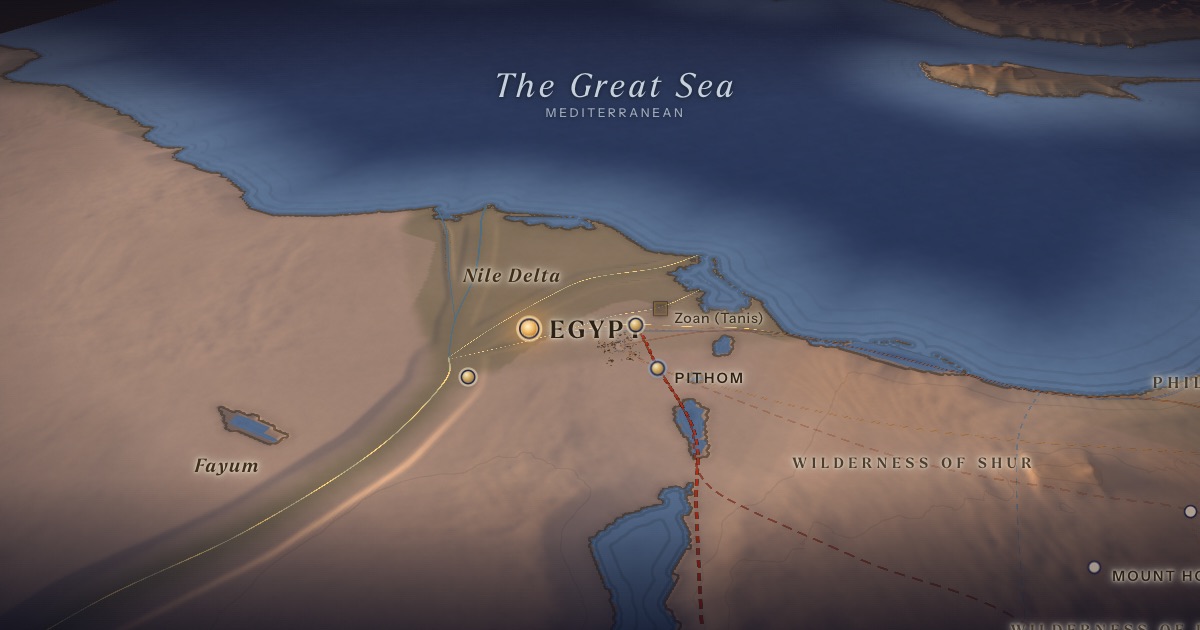
Egypt. The Torah does not name Pharaoh’s city; Psalm 78 places the wonders “in the field of Zoan” (Tanis).
- Egyptמִצְרַיִם — Nile Valley and DeltaTextually identified 30.55° N, 31.35° EThe land of the Nile — refuge in famine, and later bondage.
Related sites
- Zoan (Tanis)Biblical textPsalm 78’s “field of Zoan”; a royal city from the 11th century BCE.
- Pi-RamessesScholarly proposalRamesses II’s Delta capital.
The journey
Horeb → Egypt≈ 350 km
Roughly 10–14 days on foot. Route conjectural.
Distances are estimates along plausible ancient corridors, not measured routes.
Chronology
Moses is eighty when he speaks to Pharaoh (Exod. 7:7). The Exodus is in 1313 BCE — the Hebrew year 2448 — in Seder Olam’s reckoning.
Twelve months of judgement on Egypt (Mishnah Eduyot 2:10), ending with the death of the firstborn on the night of 15 Nisan.
Parsha
- Va’eiraוארא · Exodus 6:2
Biblical Narrative
Pharaoh increases the burden: straw is withheld but the quota of bricks remains (5:6–19). The plagues escalate from the river to the firstborn (7:14–12:30). Israel slaughters the Passover lamb, marks the doorposts and eats in haste; at midnight the firstborn of Egypt die (12:1–30).
Geography
Several plagues are rooted in Egypt’s environment: the Nile turned to blood, frogs from the river, insect swarms, locusts driven by an east wind (10:13), and a darkness some compare to the spring sandstorms (khamsin). Goshen is repeatedly spared (8:18 [Eng. 8:22]; 9:26), keeping the Israelites’ district distinct.
Historical Context
Scholars have proposed natural chains of causes for the plagues; such explanations cannot be tested and are not needed to read the text, which presents a contest between the God of Israel and “all the gods of Egypt” (12:12). The Egyptian “Admonitions of Ipuwer,” once cited as a parallel, is now generally dated and interpreted differently.
Archaeology
Tanis (Zoan) was a royal city of the 21st and 22nd Dynasties (11th–8th centuries BCE), built partly with monuments carried from Pi-Ramesses — which helps explain why later tradition, including Psalm 78, associated the Exodus with Zoan.
Jewish Tradition
The Passover Haggadah retells the plagues each year and preserves Rabbi Judah’s mnemonic for them: detzakh, adash, be-aḥav.
Traditional and rabbinic interpretation — presented as tradition, not as archaeological evidence.
Identification
- What the text says
- Egypt, and the land of Goshen (8:18 [Eng. 8:22]); no royal city is named.
- Traditional identification
- Psalm 78:12, 43: “the field of Zoan.”
- Scholarly proposals
- Pi-Ramesses is the most discussed setting, if the story reflects Ramesside Egypt.
- What remains uncertain
- The Pharaoh is unnamed; the historical setting is debated.
Sources
Hebrew Bible
- Exodus 4:18–12:36שמות ד׳:י״ח–י״ב:ל״ו
- Psalms 78:12, 43תהלים ע״ח:י״ב, מ״ג
Verse numbers follow the Hebrew (Masoretic) text. Links open the text in Hebrew and English on Sefaria.
Modern scholarship
- Nahum M. Sarna, The JPS Torah Commentary: Exodus (Philadelphia: Jewish Publication Society, 1991).
- James K. Hoffmeier, Israel in Egypt: The Evidence for the Authenticity of the Exodus Tradition (New York: Oxford University Press, 1997).
- Thomas E. Levy, Thomas Schneider and William H. C. Propp (eds.), Israel’s Exodus in Transdisciplinary Perspective (Cham: Springer, 2015).
- Donald B. Redford, Egypt, Canaan, and Israel in Ancient Times (Princeton: Princeton University Press, 1992).
Translation
- The Holy Scriptures According to the Masoretic Text (Philadelphia: Jewish Publication Society of America, 1917). Source of the short quotations on each card (public domain). Verse numbers follow the Hebrew text.