
Chapter XXXEgyptמצריםJacob
גרן האטד
The Funeral of Jacob
A great procession to Machpelah
1506 BCEHebrew year 2255traditionalב׳רנ״ה
פָּקֹד יִפְקֹד אֱלֹהִים אֶתְכֶם וְהַעֲלִתֶם אֶת־עַצְמֹתַי מִזֶּה׃
“God will surely remember you, and ye shall carry up my bones from hence.”
Jacob lives seventeen years in Egypt, blesses his sons and makes Joseph swear to bury him with his fathers. Egypt mourns seventy days. A great procession — chariots and horsemen, “a very great company” — goes up to Canaan, laments seven days at the threshing floor of Atad “beyond the Jordan,” and buries Jacob in the Cave of Machpelah. Joseph, dying, asks that his bones be carried up too.
Location
Machpelah by tradition. Goren ha-Atad is unlocated: the text says “beyond the Jordan,” while the Byzantine Madaba Map places it near Jericho.
- Cave of Machpelahמְעָרַת הַמַּכְפֵּלָה — Tomb of the Patriarchs, Hebron (Herodian enclosure)Traditional identification 31.52° N, 35.11° EBurial place of the patriarchs and matriarchs, by tradition.
Related sites
- Beth-hoglah (Madaba Map)Tradition“Alon Atath, today Bethagla” — Madaba Map.
The journey
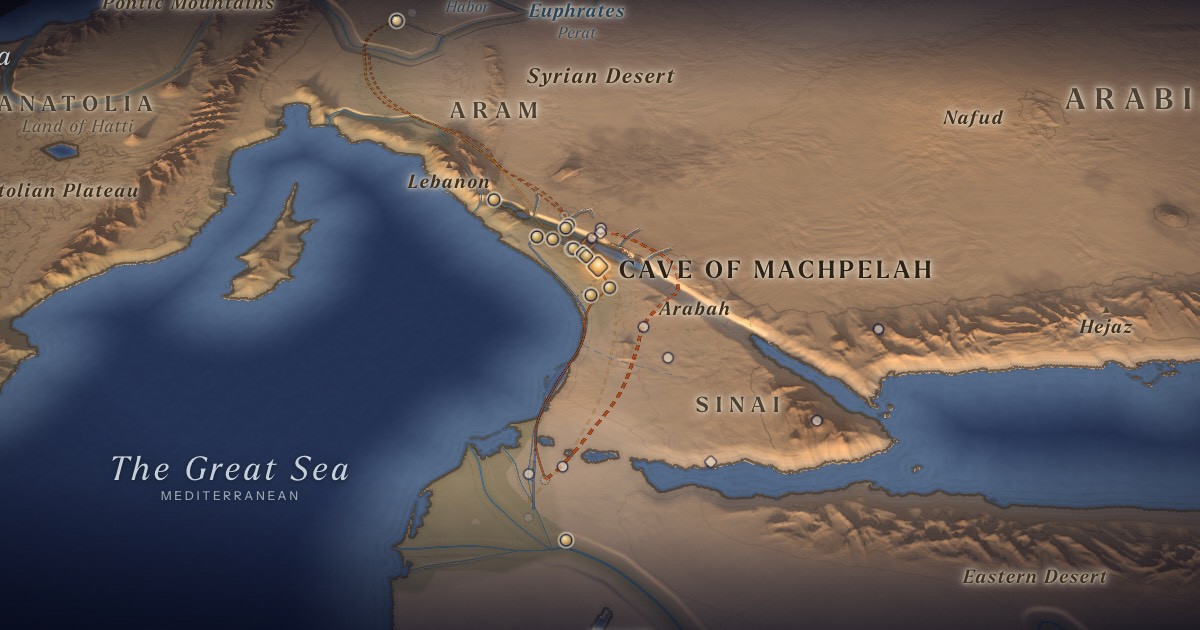
Goshen → Goren ha-Atad → Machpelah≈ 600 km
One reading of “beyond the Jordan”: around the Dead Sea. Roughly 17–24 days at caravan pace. Route conjectural.
Distances are estimates along plausible ancient corridors, not measured routes.
Chronology
Seder Olam: Jacob dies at 147 — the Hebrew year 2255; Joseph dies at 110 — 2309 (1452 BCE).
Parsha
- Vayechiויחי · Genesis 47:28
Biblical Narrative
Jacob blesses Ephraim and Manasseh (ch. 48) and his twelve sons (ch. 49). He is embalmed over forty days (50:2–3). The procession laments at Goren ha-Atad; the Canaanites name the place Abel-mizraim, “the mourning of Egypt” (50:10–11). Jacob is buried in Machpelah (50:13). Joseph dies at 110 and is embalmed and placed in a coffin in Egypt (50:26).
Geography
If “beyond the Jordan” means east of the river, the procession made a long detour — around the Dead Sea and through Transjordan, as Israel later would. Others read the phrase from a different vantage point, or place Atad west of the river. The route drawn here follows the east-bank reading and is conjectural.
Historical Context
Embalming over forty days and seventy days of mourning (50:3) accord with Egyptian practice; Joseph’s 110 years was the ideal Egyptian lifespan.
Jewish Tradition
The Madaba Map labels “Alon Atath, today Bethagla” near Jericho, identifying the threshing floor with Beth-hoglah. Joseph’s bones are carried out at the Exodus (Exod. 13:19) and buried at Shechem (Josh. 24:32).
Traditional and rabbinic interpretation — presented as tradition, not as archaeological evidence.
Identification
- What the text says
- “The threshing-floor of Atad, which is beyond the Jordan” (50:10–11); “the cave of the field of Machpelah” (50:13).
- Traditional identification
- Madaba Map (6th century CE): Goren ha-Atad = Beth-hoglah, west of the Jordan near Jericho.
- Scholarly proposals
- Scholars debate whether “beyond the Jordan” reflects an east-bank route or the writer’s perspective.
- What remains uncertain
- Atad cannot be located; Machpelah rests on tradition.
Sources
Hebrew Bible
- Genesis 47:28–50:26בראשית מ״ז:כ״ח–נ׳:כ״ו
Verse numbers follow the Hebrew (Masoretic) text. Links open the text in Hebrew and English on Sefaria.
Ancient & late-antique witnesses
- The Madaba Mosaic Map (6th century CE), Church of St George, Madaba, Jordan; see Michele Piccirillo and Eugenio Alliata (eds.), The Madaba Map Centenary 1897–1997 (Jerusalem: Studium Biblicum Franciscanum, 1999).
Modern scholarship
- Donald B. Redford, A Study of the Biblical Story of Joseph (Genesis 37–50), VTSup 20 (Leiden: Brill, 1970).
- Nahum M. Sarna, The JPS Torah Commentary: Genesis (Philadelphia: Jewish Publication Society, 1989). — on 50:10–11
Translation
- The Holy Scriptures According to the Masoretic Text (Philadelphia: Jewish Publication Society of America, 1917). Source of the short quotations on each card (public domain). Verse numbers follow the Hebrew text.