
Chapter XXIXEgyptמצריםJacob
ארץ גשן
Goshen
Jacob goes down to Egypt
1523 BCEHebrew year 2238traditionalב׳רל״ח
אַל־תִּירָא מֵרְדָה מִצְרַיְמָה כִּי־לְגוֹי גָּדוֹל אֲשִׂימְךָ שָׁם׃ אָנֹכִי אֵרֵד עִמְּךָ מִצְרַיְמָה וְאָנֹכִי אַעַלְךָ גַם־עָלֹה
“fear not to go down into Egypt; for I will there make of thee a great nation. I will go down with thee into Egypt; and I will also surely bring thee up again.”
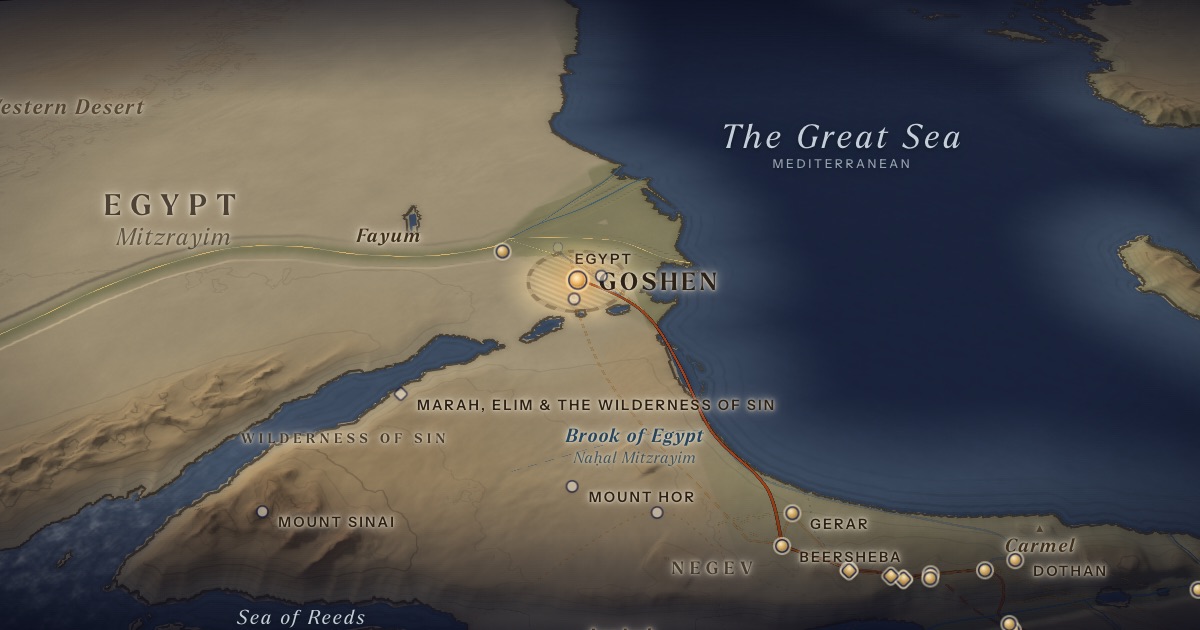
At Beersheba — the last well of the Negev — Jacob offers sacrifices and hears God say: “Fear not to go down into Egypt.” Seventy souls travel down. Joseph meets his father in Goshen and weeps on his neck. Pharaoh grants them “the best of the land,” the land of Rameses.
Location
Goshen is usually placed in the eastern Nile Delta, especially the Wadi Tumilat — a probable regional identification. The name has not been found in Egyptian sources.
- Goshenגֹּשֶׁן — Eastern Nile Delta / Wadi TumilatProbable identification 30.62° N, 31.85° EJacob’s family settles in “the best of the land.”
The journey
Hebron → Beersheba≈ 45 km
Roughly 2–4 days at the pace of flocks.
Beersheba → Goshen≈ 350 km
The coastal road into the eastern Delta. Roughly 16–27 days at the pace of flocks.
Distances are estimates along plausible ancient corridors, not measured routes.
Chronology
Jacob is 130 when he stands before Pharaoh (Gen. 47:9) — the Hebrew year 2238 in Seder Olam’s reckoning.
Parsha
- Vayigashויגש · Genesis 44:18
Biblical Narrative
Jacob sets out with all he has and comes to Beersheba (46:1). The seventy are listed by name (46:8–27). Joseph tells his brothers to say they are shepherds, “for every shepherd is an abomination unto the Egyptians” — ensuring they would be settled apart, in Goshen (46:33–34). Jacob blesses Pharaoh (47:7–10), and the family settles “in the land of Rameses” (47:11).
Geography
The eastern Delta and the Wadi Tumilat — a valley running east from the Nile toward Lake Timsah — form Egypt’s gateway to Sinai and Canaan. Well-watered but outside the densely farmed heart of Egypt, this frontier pasture is the natural place for herdsmen from Canaan to settle.
Historical Context
Egyptian texts show the pattern. Papyrus Anastasi VI (late 13th century BCE) reports that Shasu pastoralists from Edom were allowed past the frontier fortress in Tjeku to the pools of Pithom, so that they and their herds could survive. The phrase “land of Rameses” (47:11) uses a name that belongs to the 13th century BCE or later.
Archaeology
At Tell el-Dab‘a (ancient Avaris), Manfred Bietak’s excavations revealed a large population of Western Asiatic (Canaanite) origin in the Middle Bronze Age, with Levantine-style houses, burials and donkey sacrifices — the milieu from which the Hyksos kings arose. It does not identify Jacob’s family, but it shows Canaanites settling in exactly this region.
Jewish Tradition
Rashi (on Gen. 46:28, following Genesis Rabbah 95:3) says Judah was sent ahead “to show the way” by founding a house of study in Goshen.
Traditional and rabbinic interpretation — presented as tradition, not as archaeological evidence.
Identification
- What the text says
- “The land of Goshen” (45:10; 46:28–34; 47:1–6), also “the land of Rameses” (47:11), near Joseph (45:10).
- Traditional identification
- The Septuagint renders it “Gesem of Arabia” — Arabia being an Egyptian district east of the Delta.
- Scholarly proposals
- The eastern Delta and Wadi Tumilat are the standard identification (probable).
- What remains uncertain
- The name Goshen has not been found in Egyptian records; its boundaries are unknown.
Sources
Hebrew Bible
- Genesis 46:1–47:12בראשית מ״ו:א׳–מ״ז:י״ב
Verse numbers follow the Hebrew (Masoretic) text. Links open the text in Hebrew and English on Sefaria.
Jewish tradition & interpretation
Interpretive tradition — not archaeological evidence.
- Rashi (R. Shlomo Yitzḥaki, 1040–1105), Commentary on the Torah. — on Gen. 46:28רש״י על בראשית מ״ו:כ״ח
- Bereshit (Genesis) Rabbah, classical midrash on Genesis (Land of Israel, c. 5th century CE). — 95:3בראשית רבה צ״ה:ג׳
Ancient & late-antique witnesses
- Papyrus Anastasi VI (reign of Merneptah, late 13th century BCE); trans. Ricardo A. Caminos, Late-Egyptian Miscellanies (London: Oxford University Press, 1954). Records Shasu pastoralists of Edom admitted past a border fortress in Tjeku to the pools of Pithom.
Modern scholarship
- Manfred Bietak, Avaris: The Capital of the Hyksos — Recent Excavations at Tell el-Dabʿa (London: British Museum Press, 1996).
- James K. Hoffmeier, Israel in Egypt: The Evidence for the Authenticity of the Exodus Tradition (New York: Oxford University Press, 1997).
- Nahum M. Sarna, The JPS Torah Commentary: Genesis (Philadelphia: Jewish Publication Society, 1989).
Translation
- The Holy Scriptures According to the Masoretic Text (Philadelphia: Jewish Publication Society of America, 1917). Source of the short quotations on each card (public domain). Verse numbers follow the Hebrew text.