
Chapter XVPatriarchal AgeאבותAbraham
עקדת יצחק
The Binding of Isaac
Upon one of the mountains
1676 BCEHebrew year 2085traditionalב׳פ״ה
וַיִּקְרָא אַבְרָהָם שֵׁם־הַמָּקוֹם הַהוּא ה׳ יִרְאֶה אֲשֶׁר יֵאָמֵר הַיּוֹם בְּהַר ה׳ יֵרָאֶה׃
“And Abraham called the name of that place Adonai-jireh; as it is said to this day: ‘In the mount where the LORD is seen.’”
God tests Abraham: “Take now thy son, thine only son… and get thee into the land of Moriah.” On the third day Abraham sees the place from afar. Isaac is bound on the altar; an angel stops Abraham’s hand, and a ram is offered instead. Tradition identifies the mountain with the Temple Mount in Jerusalem.
Location
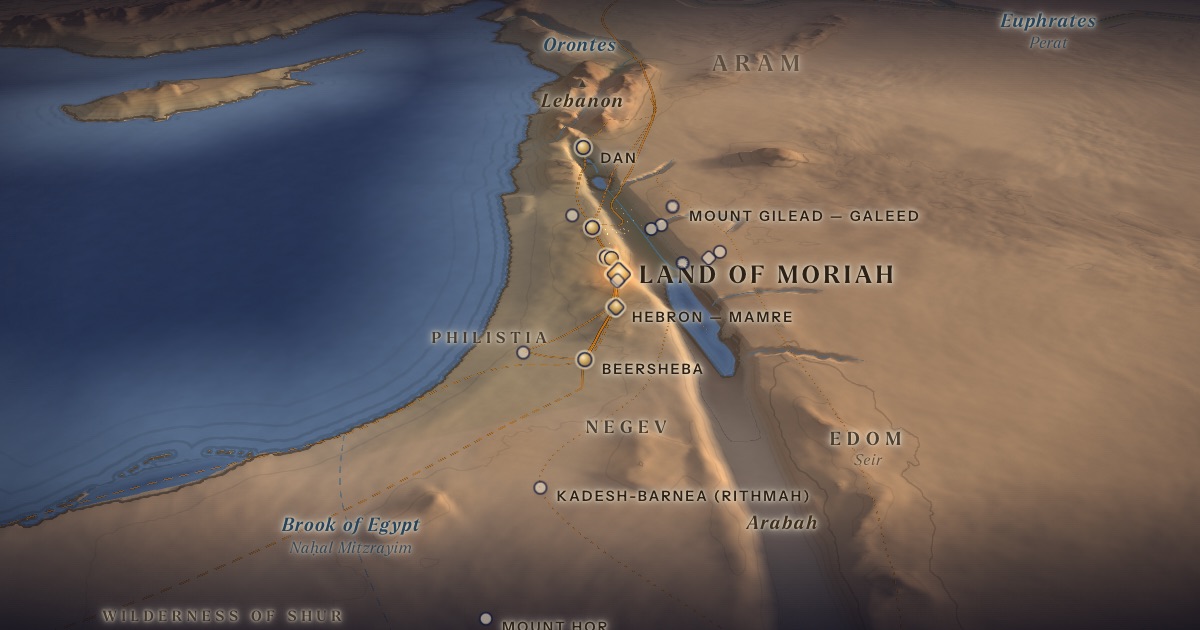
Traditionally the Temple Mount in Jerusalem, following 2 Chronicles 3:1. Genesis itself names only “the land of Moriah” and an unnamed mountain there.
- Land of Moriahאֶרֶץ הַמֹּרִיָּה — Temple Mount, Jerusalem (tradition)Traditional identification 31.78° N, 35.24° E“One of the mountains which I will tell thee of.”
Related sites
- Temple Mount, JerusalemTradition · 2 Chr. 3:1; Josephus; rabbinic traditionSite of the First and Second Temples.
- Mount GerizimTradition · Samaritan traditionThe Samaritan Pentateuch reads “land of Moreh” at Gen. 22:2.
The journey
Beersheba → Moriah≈ 80 km
Three days along the ridge road. Roughly 2–3 days on foot.
Distances are estimates along plausible ancient corridors, not measured routes.
Chronology
Seder Olam: Isaac is thirty-seven at the Akedah — the Hebrew year 2085.
Parsha
- Vayeraוירא · Genesis 18:1
Biblical Narrative
Abraham rises early, saddles his donkey and sets out with Isaac and two young men (22:3). “On the third day Abraham lifted up his eyes, and saw the place afar off” (22:4). Father and son climb alone. At the last moment an angel calls; Abraham sees a ram caught in a thicket and offers it instead (22:11–13). They return to Beersheba (22:19).
Geography
Beersheba to Jerusalem is about 80 km along the ridge road, climbing most of the way from roughly 280 m to about 750 m. At the pace of a loaded donkey and a boy, a journey of three days is just what the text describes.
Historical Context
The Chronicler, writing in the Persian period, is the first biblical writer to connect Moriah with Jerusalem: Solomon builds the Temple “in mount Moriah” (2 Chr. 3:1). Genesis 22:14’s “in the mount where the LORD is seen” already hints at a sanctuary.
Archaeology
Archaeology cannot test the identification. The Temple Mount itself has never been systematically excavated.
Jewish Tradition
Jewish tradition from the Chronicler onward — and Josephus (Antiquities 1.226) — places the Akedah on the Temple Mount; later tradition points to the Foundation Stone. The Samaritan Pentateuch reads “the land of Moreh” (compare Gen. 12:6), linking the event to Mount Gerizim near Shechem, the Samaritans’ holy mountain.
Traditional and rabbinic interpretation — presented as tradition, not as archaeological evidence.
Identification
- What the text says
- “The land of Moriah… one of the mountains which I will tell thee of” (22:2), three days from Beersheba. The mountain itself is unnamed.
- Traditional identification
- The Temple Mount in Jerusalem (2 Chr. 3:1; Josephus; rabbinic tradition). Samaritan tradition: Mount Gerizim.
- Scholarly proposals
- Scholars note that the link to Jerusalem is first explicit in Chronicles; Genesis may deliberately leave the place unnamed.
- What remains uncertain
- No historical method can confirm the site.
Sources
Hebrew Bible
- Genesis 22:1–19בראשית כ״ב:א׳–י״ט
- 2 Chronicles 3:1דברי הימים ב ג׳:א׳
Verse numbers follow the Hebrew (Masoretic) text. Links open the text in Hebrew and English on Sefaria.
Jewish tradition & interpretation
Interpretive tradition — not archaeological evidence.
- The Samaritan Pentateuch — the Torah as preserved by the Samaritan community, which reads “land of Moreh” at Gen. 22:2.
- Bereshit (Genesis) Rabbah, classical midrash on Genesis (Land of Israel, c. 5th century CE). — 56בראשית רבה נ״ו
Ancient & late-antique witnesses
- Flavius Josephus, Jewish Antiquities (c. 93–94 CE), Loeb Classical Library (Harvard University Press). — 1.226
Modern scholarship
- Nahum M. Sarna, The JPS Torah Commentary: Genesis (Philadelphia: Jewish Publication Society, 1989). — on ch. 22
Translation
- The Holy Scriptures According to the Masoretic Text (Philadelphia: Jewish Publication Society of America, 1917). Source of the short quotations on each card (public domain). Verse numbers follow the Hebrew text.