
Chapter XXIIIPatriarchal AgeאבותJacob
שכם
Shechem, in Peace
A field bought for a hundred pieces
ca. 1556–1554 BCEHebrew years 2205–2207traditionalב׳ר״ה–ב׳ר״ז
וַיָּבֹא יַעֲקֹב שָׁלֵם עִיר שְׁכֶם אֲשֶׁר בְּאֶרֶץ כְּנַעַן בְּבֹאוֹ מִפַּדַּן אֲרָם וַיִּחַן אֶת־פְּנֵי הָעִיר׃
“And Jacob came in peace to the city of Shechem, which is in the land of Canaan, when he came from Paddan-aram; and encamped before the city.”
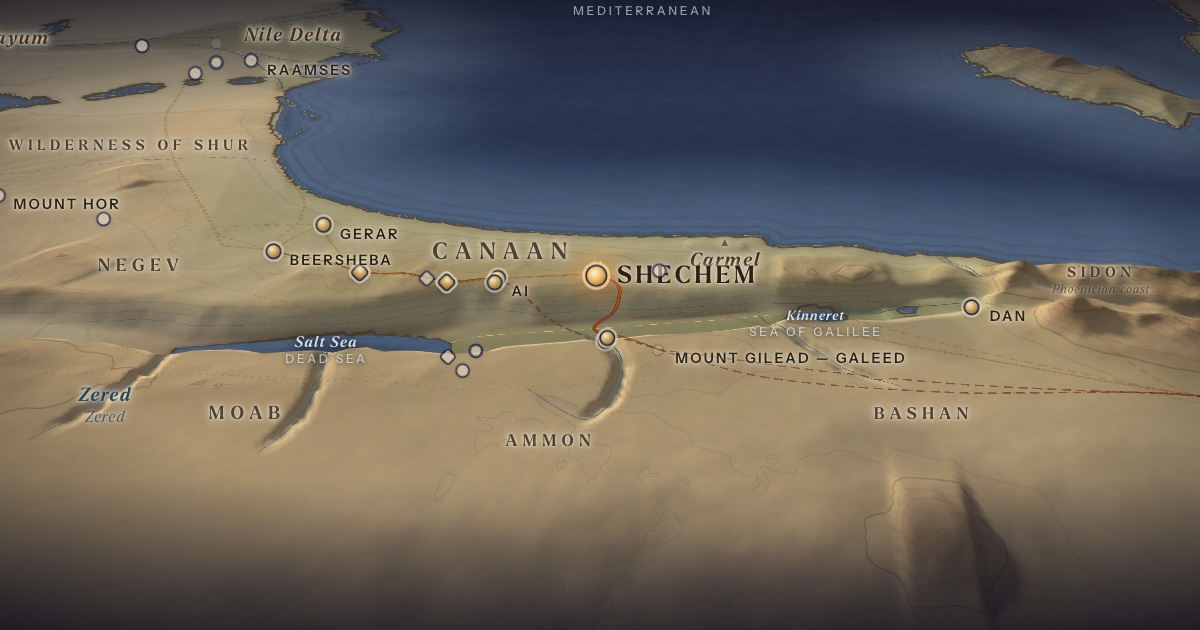
Crossing the Jordan, Jacob arrives at Shechem — where Abraham first built an altar — and buys a field for a hundred pieces of money. The peace does not last: Dinah is taken by the prince of the city, and her brothers Simeon and Levi take bloody revenge. Jacob’s family must move on.
Location
Tell Balata (Shechem); the traditional “Joseph’s Tomb” nearby commemorates the field.
- Shechemשְׁכֶם — Tell Balata, NablusProbable identification 32.21° N, 35.28° EThe first altar in Canaan, at the oak of Moreh.
Related sites
- Joseph’s Tomb, NablusTraditionTraditional site of Jacob’s field and Joseph’s burial (Josh. 24:32).
The journey
Sukkot → Shechem≈ 40 km
Across the Jordan and up the Wadi Far‘a. Roughly 2–3 days at the pace of flocks.
Distances are estimates along plausible ancient corridors, not measured routes.
Chronology
The Talmud counts two years on the road between Laban’s house and Isaac at Hebron (Megillah 17a); Shechem falls within them.
Biblical Narrative
Jacob buys the parcel of ground where he pitched his tent from the sons of Hamor and erects an altar, El-elohe-Israel (33:19–20). After Shechem son of Hamor violates Dinah, her brothers demand that the men of the city be circumcised, then attack while they are in pain (34:1–29). Jacob rebukes them: “Ye have troubled me” (34:30).
Geography
From Sukkot the way climbs the Wadi Far‘a — a gentle corridor from the Jordan valley into the heart of the hill country — to Shechem between Ebal and Gerizim. It is the same gateway Abraham probably used.
Historical Context
The purchase anticipates Joseph’s burial here centuries later: “the bones of Joseph… buried they in Shechem, in the parcel of ground which Jacob bought” (Josh. 24:32).
Archaeology
See Abraham at Shechem. The traditional Joseph’s Tomb, a small domed building at the eastern edge of Nablus, is of much later date.
Jewish Tradition
Jewish, Samaritan and Christian traditions have venerated Joseph’s Tomb near Nablus; John 4:5 speaks of “the parcel of ground that Jacob gave to his son Joseph” near Sychar.
Traditional and rabbinic interpretation — presented as tradition, not as archaeological evidence.
Identification
- What the text says
- “The city of Shechem” (33:18) and the purchased field (33:19).
- Traditional identification
- Joseph’s Tomb marks the field by tradition.
- Scholarly proposals
- Tell Balata = Shechem (probable).
- What remains uncertain
- The location of Jacob’s field and of Joseph’s actual burial is unverified.
Sources
Hebrew Bible
- Genesis 33:18–34:31בראשית ל״ג:י״ח–ל״ד:ל״א
Verse numbers follow the Hebrew (Masoretic) text. Links open the text in Hebrew and English on Sefaria.
Modern scholarship
- G. Ernest Wright, Shechem: The Biography of a Biblical City (New York: McGraw-Hill, 1965).
- Nahum M. Sarna, The JPS Torah Commentary: Genesis (Philadelphia: Jewish Publication Society, 1989).
Atlases & reference works
- Ephraim Stern (ed.), The New Encyclopedia of Archaeological Excavations in the Holy Land, 4 vols. (Jerusalem: Israel Exploration Society & Carta, 1993); vol. 5 (2008). — s.v. “Shechem”
Translation
- The Holy Scriptures According to the Masoretic Text (Philadelphia: Jewish Publication Society of America, 1917). Source of the short quotations on each card (public domain). Verse numbers follow the Hebrew text.