
Chapter XXXIVEgyptמצריםMoses
הסנה
The Burning Bush
Horeb, the mountain of God
1314 BCEHebrew year 2447traditionalב׳תמ״ז
שַׁל־נְעָלֶיךָ מֵעַל רַגְלֶיךָ כִּי הַמָּקוֹם אֲשֶׁר אַתָּה עוֹמֵד עָלָיו אַדְמַת־קֹדֶשׁ הוּא׃
“put off thy shoes from off thy feet, for the place whereon thou standest is holy ground.”
Leading Jethro’s flock to the far side of the wilderness, Moses comes to Horeb, the mountain of God, and sees a bush that burns and is not consumed. God speaks from the bush, reveals the name — “I AM THAT I AM” (Ehyeh asher ehyeh) — and sends Moses back to Pharaoh. The place is holy; its location is one of the great unsolved questions of biblical geography.
Location
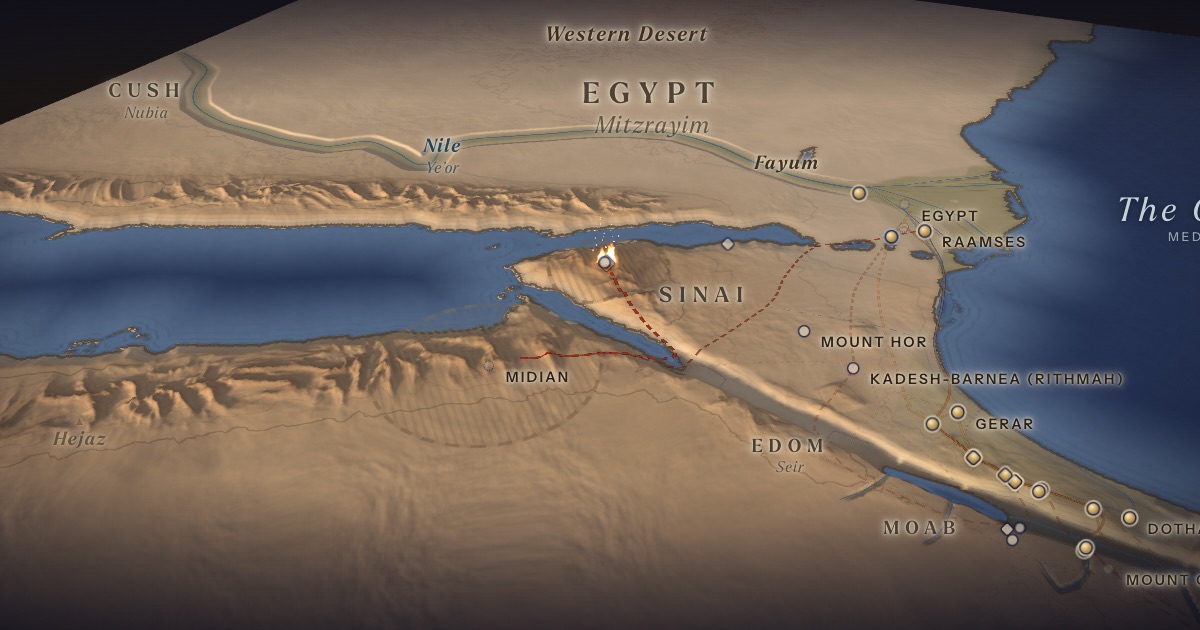
Disputed. Horeb is usually equated with Mount Sinai. The traditional site is Jebel Musa in southern Sinai, beside St Catherine’s Monastery, which preserves a bush at the site of the vision.
- Horeb, the Mountain of Godחֹרֵב — Location disputedDisputedA bush burns and is not consumed.
Proposed locations
- St Catherine’s MonasteryTraditionBuilt c. 548–565 CE around the traditional chapel of the Burning Bush.
The journey
Midian → Horeb≈ 300 km
To the traditional Horeb — one of several proposals. Roughly 14–23 days at the pace of flocks. Route conjectural.
Distances are estimates along plausible ancient corridors, not measured routes.
Chronology
A year before the Exodus; the plagues then run twelve months (Mishnah Eduyot 2:10).
Parsha
- Shemosשמות · Exodus 1:1
Biblical Narrative
Moses turns aside to see “this great sight” (3:3). God has heard Israel’s cry and promises to bring them to a land flowing with milk and honey (3:7–8). Moses protests — “Who am I?” — and receives signs: the rod that becomes a serpent, the hand that turns leprous (3:11; 4:1–9). Aaron is appointed his spokesman (4:14–16).
Geography
“He led the flock to the farthest end of the wilderness” (achar ha-midbar, 3:1) — the phrase implies Horeb lay beyond Midian’s usual pastures. Whether that means west into Sinai or elsewhere depends on where one places Midian and Sinai; the text does not settle it.
Historical Context
The divine name revealed here, YHWH, is explained by the phrase ehyeh asher ehyeh (3:14). Egyptian topographical lists of the 14th–13th centuries BCE mention “Yhw in the land of the Shasu,” apparently in the south-east — often cited in discussions of the name’s origins.
Archaeology
St Catherine’s Monastery was built by the emperor Justinian between about 548 and 565 CE, around an earlier chapel of the Burning Bush; the pilgrim Egeria was shown the bush here in the 380s. The tradition is thus at least 1,600 years old — but nothing connects the site to earlier periods.
Jewish Tradition
Rashi (on Exod. 3:2) explains that God appeared in a lowly thornbush to show that He shares Israel’s suffering: “I will be with him in trouble” (Ps. 91:15). The bush (seneh) echoes the name Sinai.
Traditional and rabbinic interpretation — presented as tradition, not as archaeological evidence.
Identification
- What the text says
- “Horeb, the mountain of God” (3:1), reached from Midian “behind the wilderness”; Horeb and Sinai name the same mountain in most of the Torah (compare 3:1; 19:11; Deut. 4:10).
- Traditional identification
- Byzantine Christian tradition, followed by many later Jews: Jebel Musa, with the monastery’s Burning Bush.
- Scholarly proposals
- See Mount Sinai: proposals range from southern and northern Sinai to the Negev and north-western Arabia.
- What remains uncertain
- The location of Horeb is unknown.
Sources
Hebrew Bible
- Exodus 3:1–4:17שמות ג׳:א׳–ד׳:י״ז
Verse numbers follow the Hebrew (Masoretic) text. Links open the text in Hebrew and English on Sefaria.
Jewish tradition & interpretation
Interpretive tradition — not archaeological evidence.
- Rashi (R. Shlomo Yitzḥaki, 1040–1105), Commentary on the Torah. — on Exod. 3:2רש״י על שמות ג׳:ב׳
Ancient & late-antique witnesses
- Egeria, Itinerarium (c. 381–384 CE); trans. John Wilkinson, Egeria’s Travels, 3rd ed. (Warminster: Aris & Phillips, 1999).
Modern scholarship
- Nahum M. Sarna, The JPS Torah Commentary: Exodus (Philadelphia: Jewish Publication Society, 1991).
- James K. Hoffmeier, Ancient Israel in Sinai: The Evidence for the Authenticity of the Wilderness Tradition (New York: Oxford University Press, 2005).
- Graham I. Davies, The Way of the Wilderness: A Geographical Study of the Wilderness Itineraries in the Old Testament (Cambridge: Cambridge University Press, 1979).
Translation
- The Holy Scriptures According to the Masoretic Text (Philadelphia: Jewish Publication Society of America, 1917). Source of the short quotations on each card (public domain). Verse numbers follow the Hebrew text.