
Chapter IPrimeval HistoryראשיתAdam
גן עדן
The Garden in Eden
Where was Eden?
1 Tishrei · 3761 BCEHebrew year 1traditionalא׳ תשרי א׳
וְנָהָר יֹצֵא מֵעֵדֶן לְהַשְׁקוֹת אֶת־הַגָּן וּמִשָּׁם יִפָּרֵד וְהָיָה לְאַרְבָּעָה רָאשִׁים׃
“And a river went out of Eden to water the garden; and from thence it was parted, and became four heads.”
Genesis places a garden “eastward, in Eden” and names four rivers that flow from it. Two are unmistakable — the Tigris and the Euphrates. The other two, the Pishon and the Gihon, have never been securely identified, and the garden itself cannot be located on any map.
Location
Unknown. The two identifiable rivers point toward Mesopotamia, but the text’s geography cannot be reconstructed with certainty.
- EdenעֵדֶןUnknownA garden planted “eastward, in Eden” — its location cannot be established.
Proposed locations
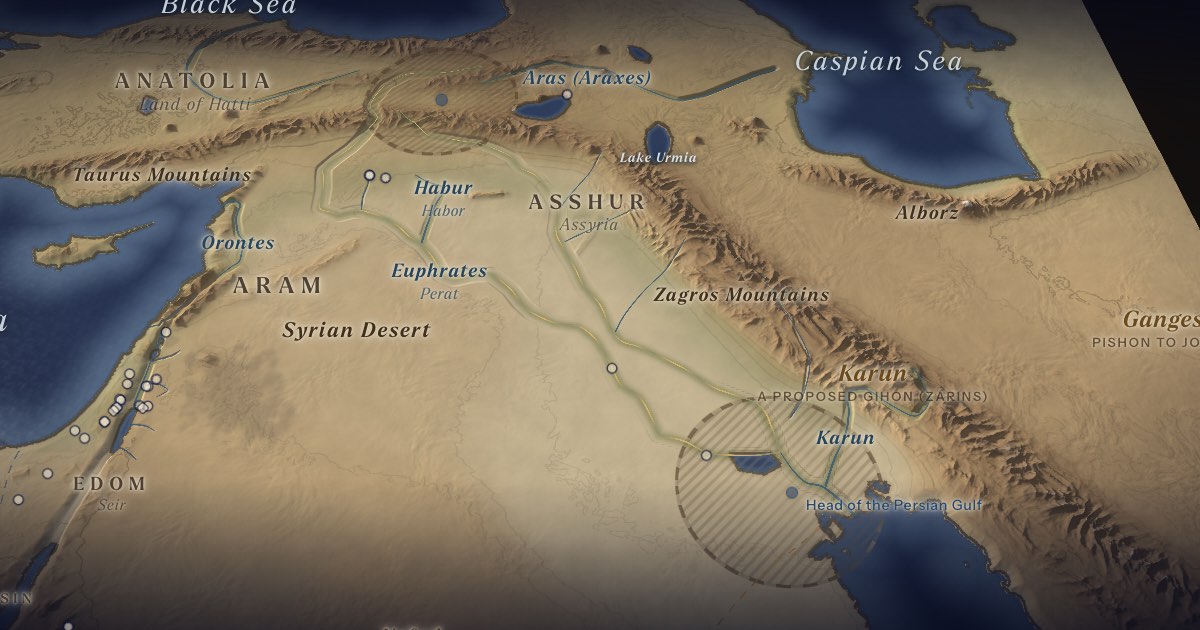
- Head of the Persian GulfScholarly proposal · J. Zarins; J. A. SauerWhere the Tigris, Euphrates, Karun and the now-dry Wadi al-Batin converge.
- Sources of the Tigris & EuphratesScholarly proposal · Various writers since the early modern periodWhere the two known rivers rise close to one another in the Armenian highlands.
Chronology
Traditional Jewish reckoning (Seder Olam) counts years from Creation. Genesis gives Adam 930 years (5:5).
Adam is created on the sixth day of Creation — Rosh Hashanah, 1 Tishrei, by the tradition (Vayikra Rabbah 29:1) — and leaves the garden that same day (Sanhedrin 38b).
Parsha
- Bereishisבראשית · Genesis 1:1
Biblical Narrative
God plants a garden in Eden and places the first human there (Gen. 2:8). A single river waters the garden and then divides into four “heads”: the Pishon, which winds through the land of Havilah, where there is gold; the Gihon, which winds through the whole land of Cush; the Hiddekel (Tigris), which flows east of Assyria; and the Perat (Euphrates) (2:10–14). After their disobedience, Adam and Eve are sent out, and cherubim guard the way to the tree of life at the east of the garden (3:24).
Geography
The Tigris and Euphrates rise within about 100 km of each other in the highlands of eastern Anatolia and reach the sea together at the head of the Persian Gulf. Between them lies the alluvial plain where some of the world’s earliest cities arose. Readings of Genesis 2 therefore tend to gravitate toward one of two ends of these rivers: their mountain sources, or their marshy mouths.
Historical Context
Mesopotamian literature also knew a paradisal land: the Sumerian myth of Enki and Ninhursag describes Dilmun — usually identified with Bahrain and the Gulf coast — as a pure land without sickness or death. The word “Eden” has been compared with Sumerian eden, “steppe,” and with a West Semitic root meaning “abundance” or “delight.”
Archaeology
No archaeological site can be identified with Eden, and the text does not describe the kind of place archaeology could find. Satellite radar imagery has, however, revealed a now-dry river system across northern Arabia — the Wadi al-Rimah and Wadi al-Batin — that flowed toward the head of the Gulf in wetter periods, and which some have proposed as the Pishon.
Jewish Tradition
Rashi (on Gen. 2:11) identifies the Pishon with the Nile. Josephus identifies the Pishon with the Ganges and the Gihon with the Nile, reflecting the view that Eden’s rivers ran to the ends of the inhabited world. The Talmud distinguishes “Eden” from “the garden” and says that no eye has ever seen Eden itself (Berakhot 34b).
Traditional and rabbinic interpretation — presented as tradition, not as archaeological evidence.
Identification
- What the text says
- The garden lies “eastward” (Gen. 2:8). Of the four rivers named, two — the Tigris and Euphrates — are real and identifiable. The Pishon (with Havilah) and the Gihon (with Cush) are not.
- Traditional identification
- Rashi: Pishon = the Nile. Josephus: Pishon = Ganges, Gihon = Nile. Classical rabbinic sources distinguish Eden from the garden and treat Eden as beyond human sight.
- Scholarly proposals
- Proposals include the head of the Persian Gulf, where the Tigris and Euphrates once met the Karun and the now-dry Wadi al-Batin (Zarins; Sauer), and the Armenian highlands, where the Tigris and Euphrates rise. Many scholars read Genesis 2:10–14 as symbolic “world geography” — four rivers running to the quarters of the known world — rather than as a map.
- What remains uncertain
- The location of Eden cannot be established historically. The map shows the rivers the text names and the regions most often proposed — not a site.
Sources
Hebrew Bible
- Genesis 2:8–14בראשית ב׳:ח׳–י״ד
- Genesis 2:4–3:24בראשית ב׳:ד׳–ג׳:כ״ד
Verse numbers follow the Hebrew (Masoretic) text. Links open the text in Hebrew and English on Sefaria.
Jewish tradition & interpretation
Interpretive tradition — not archaeological evidence.
- Rashi (R. Shlomo Yitzḥaki, 1040–1105), Commentary on the Torah. — on Gen. 2:11רש״י על בראשית ב׳:י״א
- Babylonian Talmud (Talmud Bavli), redacted c. 6th century CE. — Berakhot 34bבבלי ברכות ל״ד ב
Ancient & late-antique witnesses
- Flavius Josephus, Jewish Antiquities (c. 93–94 CE), Loeb Classical Library (Harvard University Press). — 1.38–39
Modern scholarship
- E. A. Speiser, “The Rivers of Paradise” (1959), repr. in Oriental and Biblical Studies (Philadelphia: University of Pennsylvania Press, 1967).
- James A. Sauer, “The River Runs Dry: Creation Story Preserved in Historical Memory,” Biblical Archaeology Review 22:4 (1996).
- Juris Zarins’s proposal, reported in Dora Jane Hamblin, “Has the Garden of Eden Been Located at Last?” Smithsonian 18:2 (May 1987).
- Nahum M. Sarna, The JPS Torah Commentary: Genesis (Philadelphia: Jewish Publication Society, 1989). — on 2:8–14
Translation
- The Holy Scriptures According to the Masoretic Text (Philadelphia: Jewish Publication Society of America, 1917). Source of the short quotations on each card (public domain). Verse numbers follow the Hebrew text.