
Chapter XXPatriarchal AgeאבותJacob
פדן ארם
Paddan-aram
Twenty years with Laban
1576–1556 BCEHebrew years 2185–2205traditionalב׳קפ״ה–ב׳ר״ה
וַיַּעֲבֹד יַעֲקֹב בְּרָחֵל שֶׁבַע שָׁנִים וַיִּהְיוּ בְעֵינָיו כְּיָמִים אֲחָדִים בְּאַהֲבָתוֹ אֹתָהּ׃
“And Jacob served seven years for Rachel; and they seemed unto him but a few days, for the love he had to her.”
Jacob reaches “the land of the children of the east” and finds shepherds at a well near Haran. Rachel arrives with her father’s sheep; Jacob rolls the great stone from the well’s mouth. He serves Laban seven years for Rachel, is given Leah instead, and serves seven more. In twenty years eleven sons and a daughter are born — and Jacob’s flocks multiply.
Location
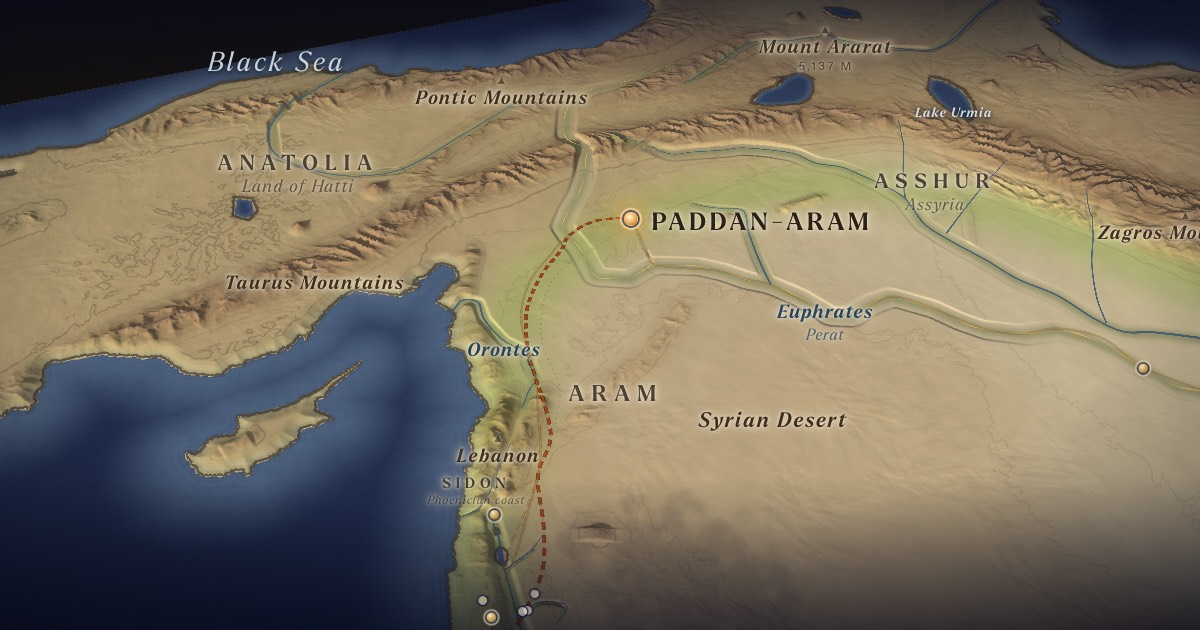
The region of Haran, called Paddan-aram (probably “the field of Aram”).
- Paddan-aramפַּדַּן אֲרָם — Region of Harran, Türkiye / SyriaProbable identification 36.86° N, 39.03° ETwenty years of labour for Laban.
The journey
Bethel → Haran≈ 800 km
Across the Jordan, north through Gilead and Syria. Roughly 22–31 days on foot. Route conjectural.
Distances are estimates along plausible ancient corridors, not measured routes.
Chronology
Seder Olam: Jacob reaches Haran at seventy-seven, after fourteen years with Shem and Eber, and leaves at ninety-seven — the Hebrew year 2205.
He marries at eighty-four, in 1569 BCE (Hebrew year 2192).
Biblical Narrative
At the well, the shepherds wait for all the flocks to gather before rolling away the stone (29:2–8). Jacob kisses Rachel and weeps (29:11). Laban deceives him on his wedding night, substituting Leah (29:23–26). Leah, Rachel, Bilhah and Zilpah bear sons; Jacob prospers through a bargain over speckled and spotted flocks (30:25–43).
Geography
Bethel to Haran is roughly 800 km. The Haran plain is fed by the Balikh springs and winter rain — good country for sheep and goats. Jacob remembers working in “drought by day, and frost by night” (31:40), a fair description of its continental climate.
Historical Context
Old Babylonian and Nuzi documents have been compared with Jacob’s arrangements with Laban — service in exchange for a bride, household gods, inheritance. Earlier scholars took these parallels as dating the patriarchs to the 2nd millennium BCE; later research showed that many of the customs were long-lived, so the parallels do not fix a date.
Jewish Tradition
All of Jacob’s children but Benjamin are born here; tradition regards Paddan-aram as the cradle of the twelve tribes.
Traditional and rabbinic interpretation — presented as tradition, not as archaeological evidence.
Identification
- What the text says
- Paddan-aram (28:2, 5–7), Haran (29:4), “the land of the children of the east” (29:1).
- Traditional identification
- Identified with the Haran region.
- Scholarly proposals
- Paddan-aram probably means “field” or “plain of Aram” — the Haran region; a probable identification.
- What remains uncertain
- Laban’s settlement and the well cannot be pinpointed.
Sources
Hebrew Bible
- Genesis 29:1–31:16בראשית כ״ט:א׳–ל״א:ט״ז
Verse numbers follow the Hebrew (Masoretic) text. Links open the text in Hebrew and English on Sefaria.
Jewish tradition & interpretation
Interpretive tradition — not archaeological evidence.
Modern scholarship
- Nahum M. Sarna, The JPS Torah Commentary: Genesis (Philadelphia: Jewish Publication Society, 1989).
- Thomas L. Thompson, The Historicity of the Patriarchal Narratives (Berlin: de Gruyter, 1974).
- John Van Seters, Abraham in History and Tradition (New Haven: Yale University Press, 1975).
- Seton Lloyd and William Brice, “Harran,” Anatolian Studies 1 (1951): 77–111.
Translation
- The Holy Scriptures According to the Masoretic Text (Philadelphia: Jewish Publication Society of America, 1917). Source of the short quotations on each card (public domain). Verse numbers follow the Hebrew text.