
Chapter IIPrimeval HistoryראשיתCain
ארץ נוד
East of Eden
Cain in the land of Nod
Not dated in the tradition
וַיֵּצֵא קַיִן מִלִּפְנֵי ה׳ וַיֵּשֶׁב בְּאֶרֶץ־נוֹד קִדְמַת־עֵדֶן׃
“And Cain went out from the presence of the LORD, and dwelt in the land of Nod, on the east of Eden.”
After killing his brother Abel, Cain is condemned to be “a fugitive and a wanderer” (na‘ va-nad). He settles in “the land of Nod” — a name built from the same root: wandering. The text gives only a direction: east of Eden.
Location
Unknown. Nod is defined only relative to Eden, which itself cannot be located.
- Land of Nodאֶרֶץ־נוֹדUnknown“On the east of Eden.” The name means “wandering.”
Chronology
Genesis does not say when Cain killed Abel. Seth is born “instead of Abel” when Adam is 130 (Gen. 4:25, 5:3).
Biblical Narrative
Cain, a tiller of the ground, kills Abel, a keeper of sheep (Gen. 4:2–8). His punishment is exile: the ground will no longer yield its strength to him, and he will be “a fugitive and a wanderer in the earth” (4:12). He dwells in the land of Nod, east of Eden, and builds a city named for his son Enoch (4:16–17).
Geography
In Genesis, movement eastward repeatedly marks distance from God’s presence: Adam and Eve are expelled toward the east of the garden (3:24), Cain goes east of Eden (4:16), and the builders of Babel journey miqedem — “from the east” or “eastward” — into Shinar (11:2). “Nod” reads as wordplay rather than a place name: the land of wandering for the man condemned to wander.
Historical Context
Genesis 4 credits Cain’s line with the first city and with the beginnings of herding, music and metalworking (4:17–22). Scholars often read these verses as an ancient reflection on the origins of civilisation, comparable to Mesopotamian traditions that credit the arts of civilisation to primeval sages.
Jewish Tradition
Rashi (on Gen. 4:16) glosses Nod as the land where all exiles wander. Genesis Rabbah (22:13) tells that Adam met Cain after his sentence and asked what had become of his judgement; Cain replied that he had repented and been granted a reprieve.
Traditional and rabbinic interpretation — presented as tradition, not as archaeological evidence.
Identification
- What the text says
- Only “on the east of Eden” (Gen. 4:16). The name Nod (נוד) means “wandering” and echoes Cain’s sentence to be a wanderer (נד, 4:12, 14).
- Traditional identification
- Traditional commentators generally read Nod as a condition of exile rather than a fixed territory.
- Scholarly proposals
- Most scholars regard Nod as a literary name rather than a geographical one.
- What remains uncertain
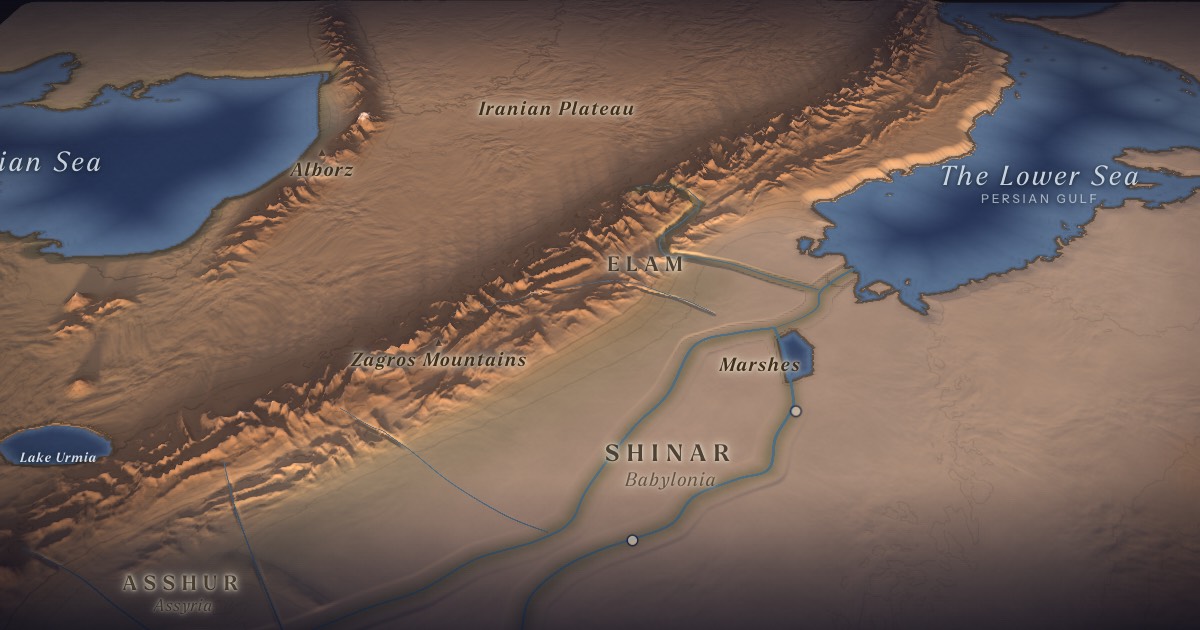
- No location can be proposed. The camera looks east — a direction, not a place.
Sources
Hebrew Bible
- Genesis 4:1–17בראשית ד׳:א׳–י״ז
Verse numbers follow the Hebrew (Masoretic) text. Links open the text in Hebrew and English on Sefaria.
Jewish tradition & interpretation
Interpretive tradition — not archaeological evidence.
- Rashi (R. Shlomo Yitzḥaki, 1040–1105), Commentary on the Torah. — on Gen. 4:16רש״י על בראשית ד׳:ט״ז
- Bereshit (Genesis) Rabbah, classical midrash on Genesis (Land of Israel, c. 5th century CE). — 22:13בראשית רבה כ״ב:י״ג
Modern scholarship
- Nahum M. Sarna, The JPS Torah Commentary: Genesis (Philadelphia: Jewish Publication Society, 1989).
Translation
- The Holy Scriptures According to the Masoretic Text (Philadelphia: Jewish Publication Society of America, 1917). Source of the short quotations on each card (public domain). Verse numbers follow the Hebrew text.