
Chapter XXXIEgyptמצריםIsraelites
פתם ורעמסס
Pithom and Raamses
A new king who knew not Joseph
1429–1313 BCEHebrew years 2332–2448traditionalב׳של״ב–ב׳תמ״ח
וַיִּבֶן עָרֵי מִסְכְּנוֹת לְפַרְעֹה אֶת־פִּתֹם וְאֶת־רַעַמְסֵס׃
“And they built for Pharaoh store-cities, Pithom and Raamses.”
The children of Israel multiply until “the land was filled with them.” A new king arises “who knew not Joseph.” Fearing them, Egypt imposes forced labour: they build the store-cities Pithom and Raamses in mortar and brick. When they still multiply, Pharaoh orders every newborn son cast into the Nile.
Location
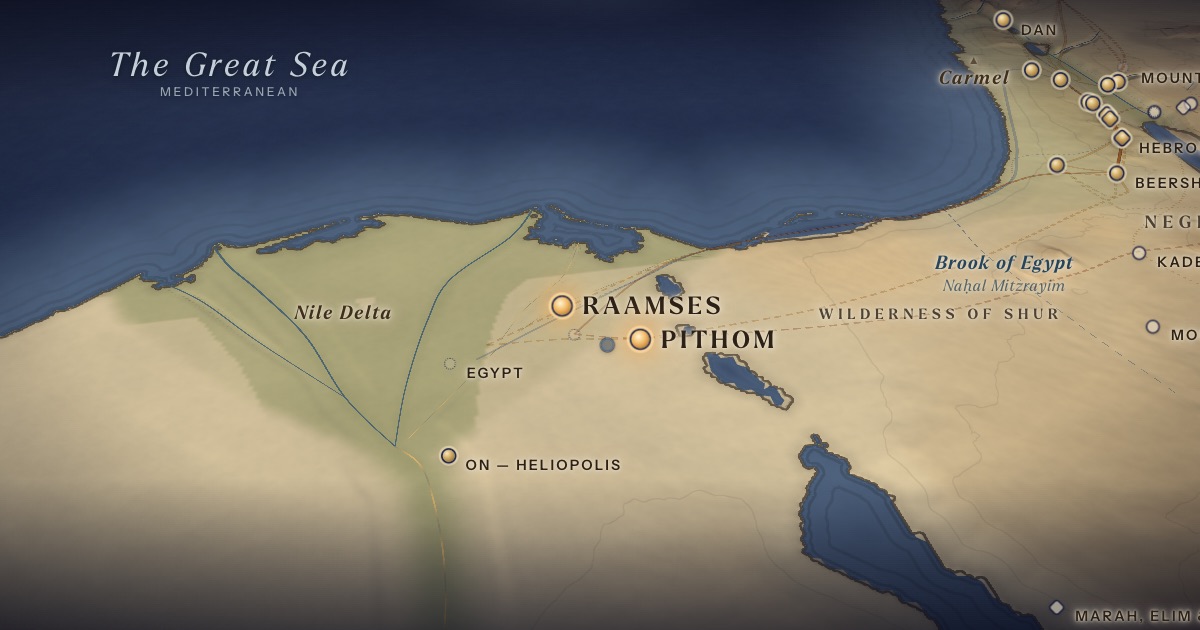
Raamses is Pi-Ramesses, the Delta capital of Ramesses II at Qantir — a probable identification. Pithom (“house of Atum”) is debated between Tell er-Retaba and Tell el-Maskhuta in the Wadi Tumilat.
- Raamsesרַעְמְסֵס — Pi-Ramesses — Qantir / Tell el-DabʿaProbable identification 30.80° N, 31.84° EA store-city built with Israelite labour.
- Pithomפִּתֹם — Tell el-Maskhuta or Tell er-RetabaDisputed 30.55° N, 32.10° EThe second store-city named in Exodus 1:11.
Related sites
- Tell er-Retaba (Pithom?)Scholarly proposalRamesside fortress and town; favoured by many for Pithom.
- Tell el-Maskhuta (Pithom?)Scholarly proposalExcavated by J. S. Holladay; mainly Middle Bronze and Saite remains.
Chronology
Seder Olam counts 210 years in Egypt (Hebrew years 2238–2448); Exodus 12:40 gives 430 years — a classic question for traditional commentators, who count the 430 from the covenant with Abraham.
Seder Olam: the bondage begins when Levi, the last of Jacob’s sons, dies; its bitterest eighty-six years are counted from Miriam’s birth (1399 BCE, Hebrew year 2362).
Biblical Narrative
The Egyptians “made their lives bitter with hard service, in mortar and in brick, and in all manner of service in the field” (1:14). Pharaoh commands the Hebrew midwives, Shiphrah and Puah, to kill newborn boys; they refuse (1:15–21). Then he orders every son cast into the river (1:22).
Geography
Both store-cities stood on the eastern frontier — Raamses on the Pelusiac branch of the Nile, Pithom in the Wadi Tumilat — guarding the roads to Sinai and Canaan. It is the same frontier zone where the text settles Jacob’s family.
Historical Context
Pi-Ramesses (“House of Ramesses”) was built by Ramesses II (reigned c. 1279–1213 BCE) and served as capital until its Nile branch silted up in the 11th century BCE. Many scholars therefore see “Raamses” as evidence that the Exodus tradition, in its present form, knows 13th-century Egypt; others see a later name updating an older story. The tomb of Rekhmire (15th century BCE) depicts foreign labourers making mud bricks under supervision.
Archaeology
Excavations at Qantir (Edgar Pusch) and adjacent Tell el-Dab‘a (Manfred Bietak) exposed palaces, stables and chariot workshops of Pi-Ramesses above the older Hyksos city of Avaris. Tell el-Maskhuta (excavated by John Holladay) has little 13th-century occupation; Tell er-Retaba has substantial New Kingdom remains, and many now favour it for Pithom.
Jewish Tradition
The Talmud (Sotah 11b) reads be-farekh, “with rigour” (1:13), as be-feh rakh, “with a soft mouth”: Pharaoh first enticed Israel into service with gentle words.
Traditional and rabbinic interpretation — presented as tradition, not as archaeological evidence.
Identification
- What the text says
- “Store-cities, Pithom and Raamses” (1:11); Rameses is also the starting point of the Exodus (12:37; Num. 33:3).
- Scholarly proposals
- Raamses = Pi-Ramesses at Qantir / Tell el-Dab‘a (probable). Pithom = Tell er-Retaba or Tell el-Maskhuta (disputed).
- What remains uncertain
- No Egyptian text mentions Israelite slaves, and the date of the oppression is debated.
Sources
Hebrew Bible
- Exodus 1:1–22שמות א׳:א׳–כ״ב
Verse numbers follow the Hebrew (Masoretic) text. Links open the text in Hebrew and English on Sefaria.
Jewish tradition & interpretation
Interpretive tradition — not archaeological evidence.
- Babylonian Talmud (Talmud Bavli), redacted c. 6th century CE. — Sotah 11bבבלי סוטה י״א ב
Ancient & late-antique witnesses
- Tomb of Rekhmire (TT100), Thebes, 15th century BCE; Norman de Garis Davies, The Tomb of Rekh-mi-Rēʿ at Thebes (New York: Metropolitan Museum of Art, 1943). Wall painting of foreign labourers making mud bricks.
Modern scholarship
- Manfred Bietak, Avaris: The Capital of the Hyksos — Recent Excavations at Tell el-Dabʿa (London: British Museum Press, 1996).
- John S. Holladay Jr., Cities of the Delta III: Tell el-Maskhuta (Malibu: Undena, 1982).
- James K. Hoffmeier, Israel in Egypt: The Evidence for the Authenticity of the Exodus Tradition (New York: Oxford University Press, 1997).
- Donald B. Redford, Egypt, Canaan, and Israel in Ancient Times (Princeton: Princeton University Press, 1992).
- Nahum M. Sarna, The JPS Torah Commentary: Exodus (Philadelphia: Jewish Publication Society, 1991).
Translation
- The Holy Scriptures According to the Masoretic Text (Philadelphia: Jewish Publication Society of America, 1917). Source of the short quotations on each card (public domain). Verse numbers follow the Hebrew text.