
Chapter XIIPatriarchal AgeאבותAbraham
מלחמת המלכים
The War of the Kings
Pursuit to Dan; Melchizedek of Salem
Not dated in the tradition
וּמַלְכִּי־צֶדֶק מֶלֶךְ שָׁלֵם הוֹצִיא לֶחֶם וָיָיִן וְהוּא כֹהֵן לְאֵל עֶלְיוֹן׃
“And Melchizedek king of Salem brought forth bread and wine; and he was priest of God the Most High.”
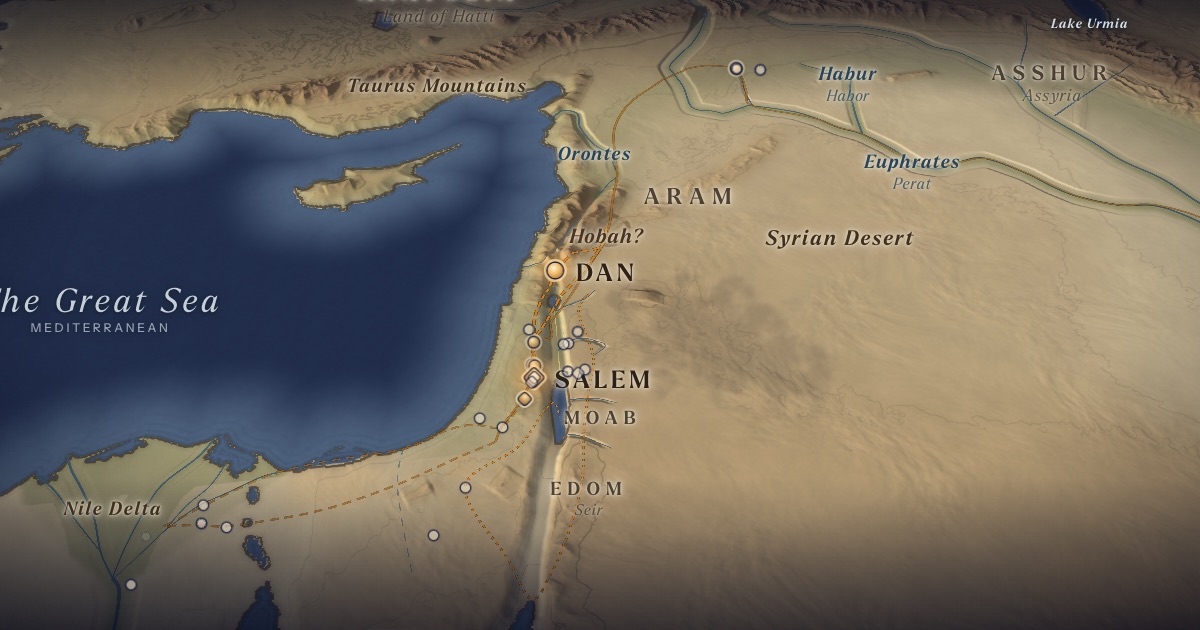
Four kings from the east — led by Chedorlaomer of Elam — sweep down through Transjordan, defeat the kings of the Jordan plain and carry off Lot. Abram musters 318 men, pursues them to Dan and beyond Damascus, and recovers the captives. On his return, Melchizedek, king of Salem, blesses him.
Location
Dan (Tel Dan) is probable; Salem is traditionally Jerusalem; Hobah, “on the left hand of Damascus,” is unknown.
- Danדָּן — Tel DanProbable identification 33.25° N, 35.65° EAbram pursues the eastern kings “as far as Dan.”
- Salemשָׁלֵם — Jerusalem (traditional identification)Traditional identification 31.78° N, 35.23° EMelchizedek, king of Salem, brings out bread and wine.
The journey
Campaign of the four kings≈ 700 km
Down the King’s Highway and back by Kadesh. Roughly 21–29 days on foot. Route conjectural.
Hebron → Dan≈ 200 km
North through the hill country. Roughly 6–9 days on foot. Route conjectural.
Dan → Hobah≈ 110 km
Past Damascus. Roughly 3–4 days on foot. Route conjectural.
Return to Salem≈ 250 km
Back through Bashan and the hill country. Roughly 8–11 days on foot. Route conjectural.
Distances are estimates along plausible ancient corridors, not measured routes.
Chronology
The tradition gives the war no fixed year. Genesis 15 follows “after these things,” but Seder Olam dates that covenant to 1743 BCE (Hebrew year 2018), before Abram left Haran.
Biblical Narrative
Amraphel of Shinar, Arioch of Ellasar, Chedorlaomer of Elam and Tidal “king of Goiim” subdue peoples from Bashan to El-paran, then defeat the five kings of the plain in the Vale of Siddim (14:1–10). Hearing that Lot is captive, Abram arms 318 trained men, pursues “unto Dan,” attacks by night and chases the invaders to Hobah (14:14–15). Melchizedek brings bread and wine; Abram gives him a tenth and refuses any spoil from the king of Sodom (14:18–24).
Geography
The invaders’ route follows the line of the King’s Highway down the Transjordan plateau — through Ashteroth-karnaim in Bashan, Moab and Seir to El-paran near the Gulf of Aqaba — then swings back by Kadesh and Hazazon-tamar to the Dead Sea (14:5–7). Abram’s pursuit from Hebron to Dan runs the whole length of the land, some 200 km.
Historical Context
None of the four kings has been securely identified in Mesopotamian records, despite many attempts; the old equation of Amraphel with Hammurabi is now generally rejected. The name Dan is itself anachronistic: the city was called Laish until the tribe of Dan captured it (Judg. 18:29).
Archaeology
Tel Dan preserves a Middle Bronze Age mud-brick gate with three arches, among the oldest standing arched gateways in the world. It was also at Tel Dan that the 9th-century BCE Aramaic stela mentioning the “House of David” was found (1993–94).
Jewish Tradition
Salem has been identified with Jerusalem since antiquity (Ps. 76:3; Targum Onkelos on Gen. 14:18 renders “king of Jerusalem”). The Talmud identifies Melchizedek with Shem, son of Noah (Nedarim 32b).
Traditional and rabbinic interpretation — presented as tradition, not as archaeological evidence.
Identification
- What the text says
- Dan (14:14); Hobah “on the left hand of Damascus” — that is, to its north (14:15); Salem (14:18); the Vale of Shaveh, “the King’s Vale” (14:17).
- Traditional identification
- Salem = Jerusalem (Ps. 76:3; Onkelos); the King’s Vale near Jerusalem (compare 2 Sam. 18:18).
- Scholarly proposals
- Tel Dan is securely identified. The eastern kings’ campaign has no confirmed extra-biblical parallel; scholars differ widely over the chapter’s date and historicity.
- What remains uncertain
- Hobah is unknown; the course of the pursuit beyond Damascus is conjectural.
Sources
Hebrew Bible
- Genesis 14:1–24בראשית י״ד:א׳–כ״ד
Verse numbers follow the Hebrew (Masoretic) text. Links open the text in Hebrew and English on Sefaria.
Jewish tradition & interpretation
Interpretive tradition — not archaeological evidence.
- Targum Onkelos, the classical Aramaic translation of the Torah (early first millennium CE). — on Gen. 14:18תרגום אונקלוס על בראשית י״ד:י״ח
- Babylonian Talmud (Talmud Bavli), redacted c. 6th century CE. — Nedarim 32bבבלי נדרים ל״ב ב
Modern scholarship
- Nahum M. Sarna, The JPS Torah Commentary: Genesis (Philadelphia: Jewish Publication Society, 1989). — on ch. 14
- Kenneth A. Kitchen, On the Reliability of the Old Testament (Grand Rapids: Eerdmans, 2003).
- John Van Seters, Abraham in History and Tradition (New Haven: Yale University Press, 1975).
Atlases & reference works
- Ephraim Stern (ed.), The New Encyclopedia of Archaeological Excavations in the Holy Land, 4 vols. (Jerusalem: Israel Exploration Society & Carta, 1993); vol. 5 (2008). — s.v. “Dan”
- Anson F. Rainey and R. Steven Notley, The Sacred Bridge: Carta’s Atlas of the Biblical World (Jerusalem: Carta, 2006).
Translation
- The Holy Scriptures According to the Masoretic Text (Philadelphia: Jewish Publication Society of America, 1917). Source of the short quotations on each card (public domain). Verse numbers follow the Hebrew text.