
Chapter XIVPatriarchal AgeאבותAbraham
באר שבע
Beersheba
The well of the oath
Nisan · 1713 BCEHebrew year 2048traditionalניסן ב׳מ״ח
עַל־כֵּן קָרָא לַמָּקוֹם הַהוּא בְּאֵר שָׁבַע כִּי שָׁם נִשְׁבְּעוּ שְׁנֵיהֶם׃
“Wherefore that place was called Beer-sheba; because there they swore both of them.”
In the Negev, Isaac is born. Hagar and Ishmael are sent into the wilderness of Beersheba, where an angel shows Hagar a well. Abraham makes a treaty with Abimelech of Gerar over a disputed well and names the place Beersheba — “well of the oath,” or “well of seven.”
Location
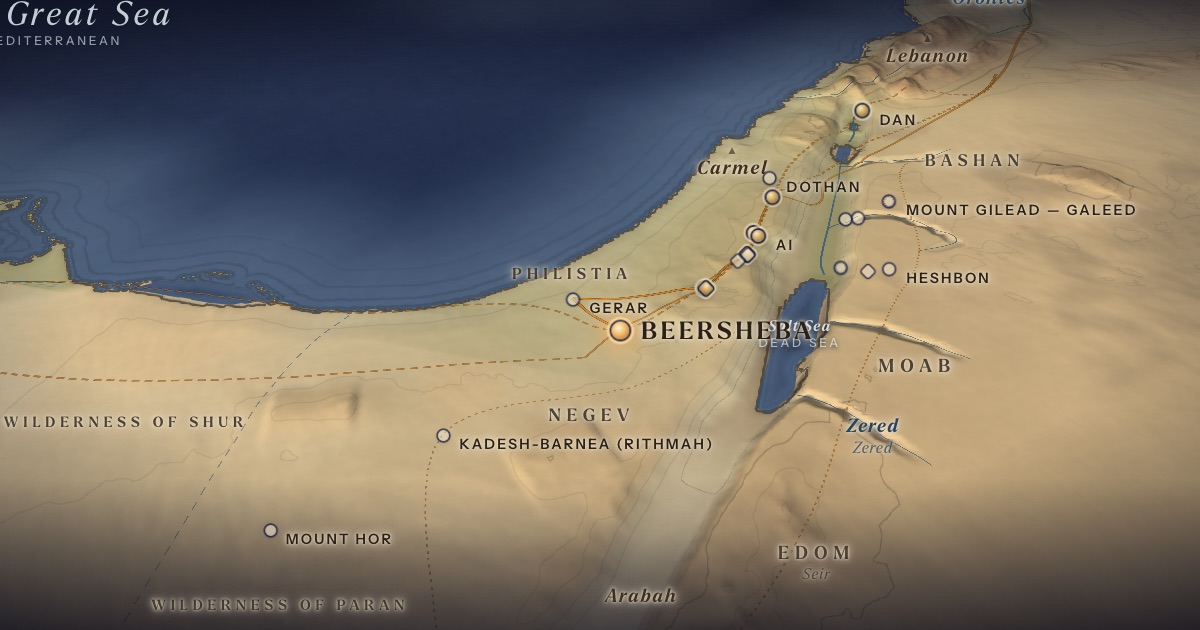
The biblical town is usually identified with Tel Beersheba, east of the modern city; the patriarchal stories concern wells and pasture rather than a town.
- Beershebaבְּאֵר שָׁבַע — Tel Beersheba / Bir es-SebaʿProbable identification 31.25° N, 34.84° EThe well of the oath, and a tamarisk planted.
The journey
Hebron → Gerar≈ 55 km
Down to the western Negev. Roughly 3–4 days at the pace of flocks.
Gerar → Beersheba≈ 30 km
Roughly 1–2 days at the pace of flocks.
Distances are estimates along plausible ancient corridors, not measured routes.
Chronology
Abraham is 100 at Isaac’s birth (21:5) — the Hebrew year 2048 in Seder Olam’s reckoning.
Isaac is born at Passover, says the Talmud (Rosh Hashanah 11a).
Biblical Narrative
Abraham journeys toward the Negev and sojourns in Gerar (20:1). Isaac is born (21:1–7). Hagar and Ishmael wander in the wilderness of Beersheba until God opens Hagar’s eyes to a well; Ishmael grows up in the wilderness of Paran (21:14–21). Abraham gives Abimelech seven ewe-lambs as witness that he dug the well; they swear an oath, and Abraham plants a tamarisk and calls on “the Everlasting God” (21:27–33).
Geography
Beersheba stands at the northern edge of the Negev, near the line where average rainfall drops to about 200 mm a year — roughly the limit of dry farming. North of it, grain can be grown in most years; south of it, life depends on wells and herding. That is why wells, and the right to them, dominate the patriarchs’ Negev stories. “From Dan even to Beer-sheba” later became the Bible’s phrase for the whole land.
Historical Context
Pastoral groups in the Negev moved seasonally between wells and winter pasture, negotiating access with settled towns — the pattern reflected in the treaties with Abimelech of Gerar.
Archaeology
Tel Beersheba, excavated by Yohanan Aharoni and Ze’ev Herzog, was a planned Iron Age town with a deep well by its gate and a large horned altar. The fortified town dates to the Iron Age; no Middle or Late Bronze Age settlement has been found at the tell.
Jewish Tradition
The sages debated the tamarisk (eshel): one held it was an orchard, another an inn for travellers (Genesis Rabbah 54:6; Sotah 10a). The second reading — hospitality — became central to the Jewish portrait of Abraham.
Traditional and rabbinic interpretation — presented as tradition, not as archaeological evidence.
Identification
- What the text says
- Beersheba (21:31–33; 22:19; 26:23, 33; 28:10; 46:1).
- Traditional identification
- The name has stayed attached to the area — Bir es-Seba‘ in Arabic.
- Scholarly proposals
- Tel Beersheba is the usual identification of the biblical town; the patriarchal wells need not have been at the tell itself.
- What remains uncertain
- The location of Abraham’s well is unknown; several wells in the modern city have been so named by tradition.
Sources
Hebrew Bible
- Genesis 20:1בראשית כ׳:א׳
- Genesis 21:1–34בראשית כ״א:א׳–ל״ד
Verse numbers follow the Hebrew (Masoretic) text. Links open the text in Hebrew and English on Sefaria.
Jewish tradition & interpretation
Interpretive tradition — not archaeological evidence.
- Bereshit (Genesis) Rabbah, classical midrash on Genesis (Land of Israel, c. 5th century CE). — 54:6בראשית רבה נ״ד:ו׳
- Babylonian Talmud (Talmud Bavli), redacted c. 6th century CE. — Sotah 10aבבלי סוטה י׳ א
Modern scholarship
- Ze’ev Herzog and Lily Singer-Avitz (eds.), Beer-sheba III: The Early Iron IIA Enclosed Settlement and the Late Iron IIA–Iron IIB Cities (Winona Lake: Eisenbrauns, 2016).
- Nahum M. Sarna, The JPS Torah Commentary: Genesis (Philadelphia: Jewish Publication Society, 1989).
Atlases & reference works
- Ephraim Stern (ed.), The New Encyclopedia of Archaeological Excavations in the Holy Land, 4 vols. (Jerusalem: Israel Exploration Society & Carta, 1993); vol. 5 (2008). — s.v. “Beersheba”
- Yohanan Aharoni, The Land of the Bible: A Historical Geography, rev. ed., trans. A. F. Rainey (Philadelphia: Westminster, 1979).
Translation
- The Holy Scriptures According to the Masoretic Text (Philadelphia: Jewish Publication Society of America, 1917). Source of the short quotations on each card (public domain). Verse numbers follow the Hebrew text.