
Chapter XXVPatriarchal AgeאבותJacob
ממרא קרית הארבע
Home to Hebron
Isaac is gathered to his people
1533 BCEHebrew year 2228traditionalב׳רכ״ח
וַיָּבֹא יַעֲקֹב אֶל־יִצְחָק אָבִיו מַמְרֵא קִרְיַת הָאַרְבַּע הִוא חֶבְרוֹן אֲשֶׁר־גָּר־שָׁם אַבְרָהָם וְיִצְחָק׃
“And Jacob came unto Isaac his father to Mamre, to Kiriath-arba—the same is Hebron—where Abraham and Isaac sojourned.”
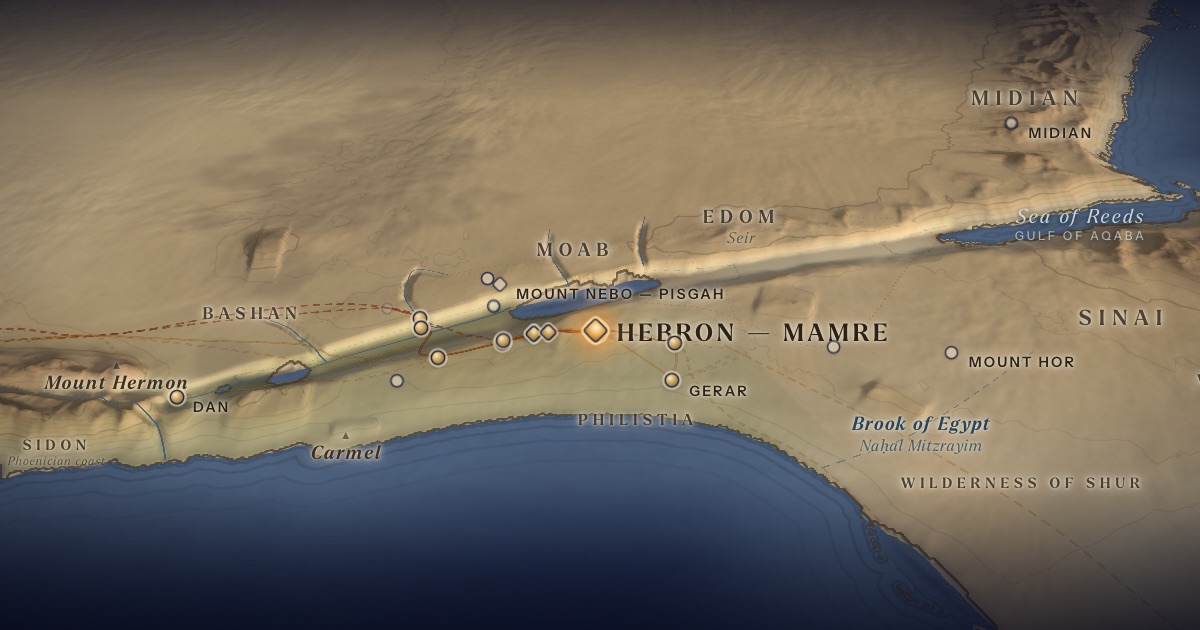
Jacob journeys on past Migdal-eder and comes at last to his father at Mamre. Isaac dies at 180, “old and full of days,” and Esau and Jacob bury him together. Esau moves to Seir; Jacob settles in the vale of Hebron — the home from which Joseph will be sent to find his brothers.
Location
Hebron (Tel Rumeida); Isaac’s burial, by tradition, in the Cave of Machpelah.
- Hebron — Mamreחֶבְרוֹן — Tel Rumeida, HebronProbable identification 31.52° N, 35.10° EAbraham settles by the terebinths of Mamre.
- Cave of Machpelahמְעָרַת הַמַּכְפֵּלָה — Tomb of the Patriarchs, Hebron (Herodian enclosure)Traditional identification 31.52° N, 35.11° EBurial place of the patriarchs and matriarchs, by tradition.
The journey
Ephrath → Hebron≈ 25 km
Roughly 1–2 days at the pace of flocks.
Distances are estimates along plausible ancient corridors, not measured routes.
Chronology
Isaac dies at 180 (Gen. 35:28) — twelve years after Joseph is sold, though Genesis tells it first.
Biblical Narrative
Israel spreads his tent beyond Migdal-eder (35:21). The twelve sons are listed (35:22–26). Isaac dies and is buried by his sons (35:28–29). Esau moves to Seir, “for their substance was too great for them to dwell together” (36:6–8). Jacob dwells “in the land of his father’s sojournings” (37:1).
Geography
Esau’s departure to Seir — the highlands of Edom, south-east of the Dead Sea — mirrors Lot’s parting from Abraham: once again the land cannot hold two households of flocks.
Historical Context
Genesis 36 lists the kings who reigned in Edom “before there reigned any king over the children of Israel” (36:31) — a verse that seems to presuppose Israel’s monarchy, and a classic text in discussions of how the Torah was composed.
Jewish Tradition
Ibn Ezra (on Gen. 36:31) reports that a scholar named Yitzḥaki dated this passage to the days of King Jehoshaphat — and rejects the view vehemently: “his book deserves to be burned.” Tradition places Migdal-eder near Bethlehem.
Traditional and rabbinic interpretation — presented as tradition, not as archaeological evidence.
Identification
- What the text says
- Mamre, Kiriath-arba, Hebron (35:27); “the vale of Hebron” (37:14).
- Traditional identification
- Isaac is buried in Machpelah (35:29; 49:31).
- Scholarly proposals
- See Hebron — the Oaks of Mamre.
- What remains uncertain
- Migdal-eder (“tower of the flock,” 35:21) is unknown.
Sources
Hebrew Bible
- Genesis 35:21–29בראשית ל״ה:כ״א–כ״ט
- Genesis 36:6–8בראשית ל״ו:ו׳–ח׳
- Genesis 37:1, 14בראשית ל״ז:א׳, י״ד
Verse numbers follow the Hebrew (Masoretic) text. Links open the text in Hebrew and English on Sefaria.
Jewish tradition & interpretation
Interpretive tradition — not archaeological evidence.
- Abraham ibn Ezra (1089–1167), Commentary on the Torah. — on Gen. 36:31אבן עזרא על בראשית ל״ו:ל״א
Modern scholarship
- Nahum M. Sarna, The JPS Torah Commentary: Genesis (Philadelphia: Jewish Publication Society, 1989).
Atlases & reference works
- Ephraim Stern (ed.), The New Encyclopedia of Archaeological Excavations in the Holy Land, 4 vols. (Jerusalem: Israel Exploration Society & Carta, 1993); vol. 5 (2008). — s.v. “Hebron”
Translation
- The Holy Scriptures According to the Masoretic Text (Philadelphia: Jewish Publication Society of America, 1917). Source of the short quotations on each card (public domain). Verse numbers follow the Hebrew text.