
Chapter IXPatriarchal AgeאבותAbraham
וירד אברם מצרימה
Down to Egypt
Famine in the land
Not dated in the tradition
וַיְהִי רָעָב בָּאָרֶץ וַיֵּרֶד אַבְרָם מִצְרַיְמָה לָגוּר שָׁם כִּי־כָבֵד הָרָעָב בָּאָרֶץ׃
“And there was a famine in the land; and Abram went down into Egypt to sojourn there; for the famine was sore in the land.”
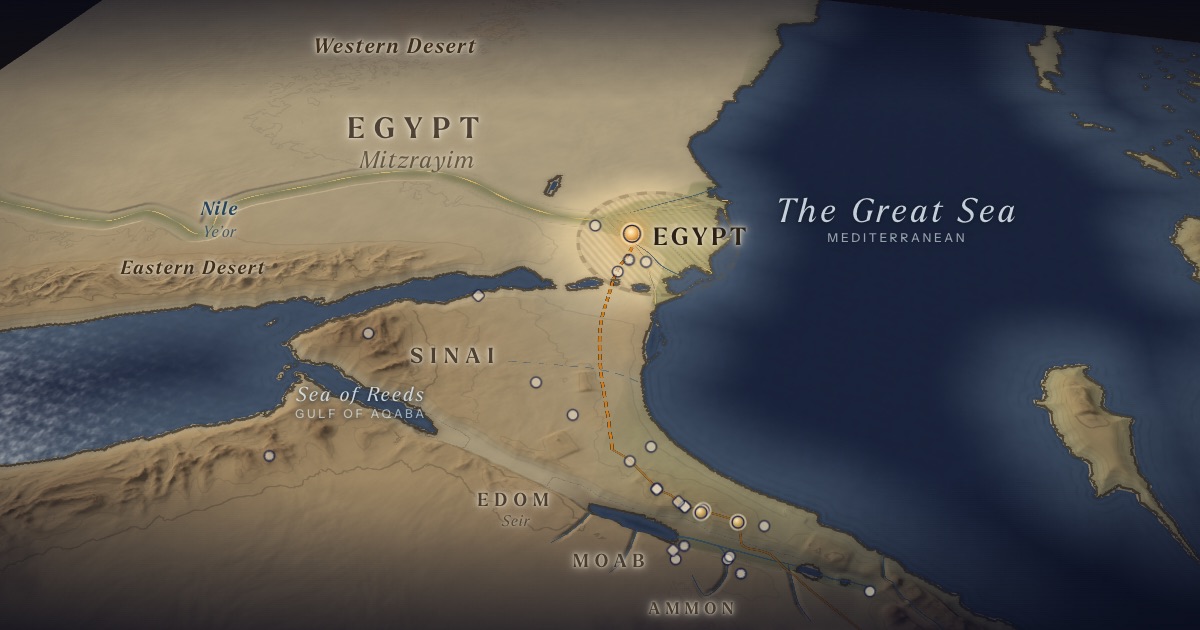
When famine strikes Canaan, Abram goes down to Egypt, whose harvests depended on the Nile rather than on local rain. Fearing for his life, he presents Sarai as his sister; she is taken into Pharaoh’s house until plagues reveal the truth, and Abram is sent away — with great wealth.
Location
Egypt is certain; the text names no city. The eastern Nile Delta, nearest to Canaan, is the most natural setting.
- Egyptמִצְרַיִם — Nile Valley and DeltaTextually identified 30.55° N, 31.35° EThe land of the Nile — refuge in famine, and later bondage.
The journey
The Negev → Egypt≈ 350 km
By “the way to Shur” across northern Sinai. Roughly 17–29 days at the pace of flocks. Route conjectural.
Distances are estimates along plausible ancient corridors, not measured routes.
Chronology
The famine follows Abram’s arrival in Canaan (1738 BCE, Hebrew year 2023); the tradition gives the descent to Egypt no year of its own.
Biblical Narrative
Abram asks Sarai to say she is his sister (12:11–13). Pharaoh’s officials praise her beauty and she is taken into his house; Abram receives flocks, cattle and servants (12:15–16). God strikes Pharaoh’s household with plagues; Pharaoh rebukes Abram and sends him away, and Abram goes up into the Negev with all he has (12:17–13:1).
Geography
Canaan’s farming depends on winter rains that fail in some years; Egypt’s depends on the Nile flood, fed by rains far away in Africa. In a drought, the Delta was the obvious refuge. From the Negev to the eastern Delta is roughly 350 km across northern Sinai — about two weeks on foot. Abram’s descent foreshadows, in miniature, Israel’s later descent into Egypt and exodus with plagues and wealth.
Historical Context
Egyptian sources show Semitic-speaking people from Canaan entering Egypt as traders, workers and pastoralists. A tomb painting at Beni Hasan (c. 1890 BCE) shows a caravan of 37 “Aamu” (Asiatics) led by a chief named Abisha; during the Middle Bronze Age a large Asiatic population grew up in the eastern Delta around Avaris.
Archaeology
Egyptian records do not mention Abram or this episode. Their value is contextual: they show that movement between Canaan and the Delta was normal.
Jewish Tradition
Ramban (on Gen. 12:10) criticises Abram sharply for leaving the land and endangering Sarai — “a great sin, committed unwittingly” — and sees the episode as a sign of Israel’s future exile in Egypt, in keeping with his principle that “the deeds of the fathers are a sign for the children.”
Traditional and rabbinic interpretation — presented as tradition, not as archaeological evidence.
Identification
- What the text says
- “Egypt” and “Pharaoh” (12:10–20) — no city or king is named.
- Traditional identification
- Tradition does not fix a location.
- Scholarly proposals
- “Pharaoh” (“great house”) is attested as a title for the king from the New Kingdom onward; the story cannot be tied to a specific reign.
- What remains uncertain
- Where in Egypt Abram stayed is unknown.
Sources
Hebrew Bible
- Genesis 12:10–13:1בראשית י״ב:י׳–י״ג:א׳
Verse numbers follow the Hebrew (Masoretic) text. Links open the text in Hebrew and English on Sefaria.
Jewish tradition & interpretation
Interpretive tradition — not archaeological evidence.
- Ramban (Naḥmanides, R. Moshe ben Naḥman, 1194–1270), Commentary on the Torah. — on Gen. 12:10רמב״ן על בראשית י״ב:י׳
Ancient & late-antique witnesses
- Tomb of Khnumhotep II, Beni Hasan (c. 1890 BCE); see Janice Kamrin, “The Aamu of Shu in the Tomb of Khnumhotep II at Beni Hassan,” Journal of Ancient Egyptian Interconnections 1:3 (2009): 22–36.
Modern scholarship
- Manfred Bietak, Avaris: The Capital of the Hyksos — Recent Excavations at Tell el-Dabʿa (London: British Museum Press, 1996).
- Donald B. Redford, Egypt, Canaan, and Israel in Ancient Times (Princeton: Princeton University Press, 1992).
- Nahum M. Sarna, The JPS Torah Commentary: Genesis (Philadelphia: Jewish Publication Society, 1989).
Translation
- The Holy Scriptures According to the Masoretic Text (Philadelphia: Jewish Publication Society of America, 1917). Source of the short quotations on each card (public domain). Verse numbers follow the Hebrew text.