
Chapter XXIIPatriarchal AgeאבותJacob
פניאל
Peniel
Wrestling at the Jabbok
1556 BCEHebrew year 2205traditionalב׳ר״ה
וַיִּקְרָא יַעֲקֹב שֵׁם הַמָּקוֹם פְּנִיאֵל כִּי־רָאִיתִי אֱלֹהִים פָּנִים אֶל־פָּנִים וַתִּנָּצֵל נַפְשִׁי׃
“And Jacob called the name of the place Peniel: ‘for I have seen God face to face, and my life is preserved.’”
Angels meet Jacob at Mahanaim. Learning that Esau approaches with four hundred men, he sends gifts ahead and brings his family across the Jabbok by night. Left alone, he wrestles with a mysterious man until dawn and is renamed Israel. The next day the brothers meet and embrace. Jacob then turns aside to Sukkot.
Location
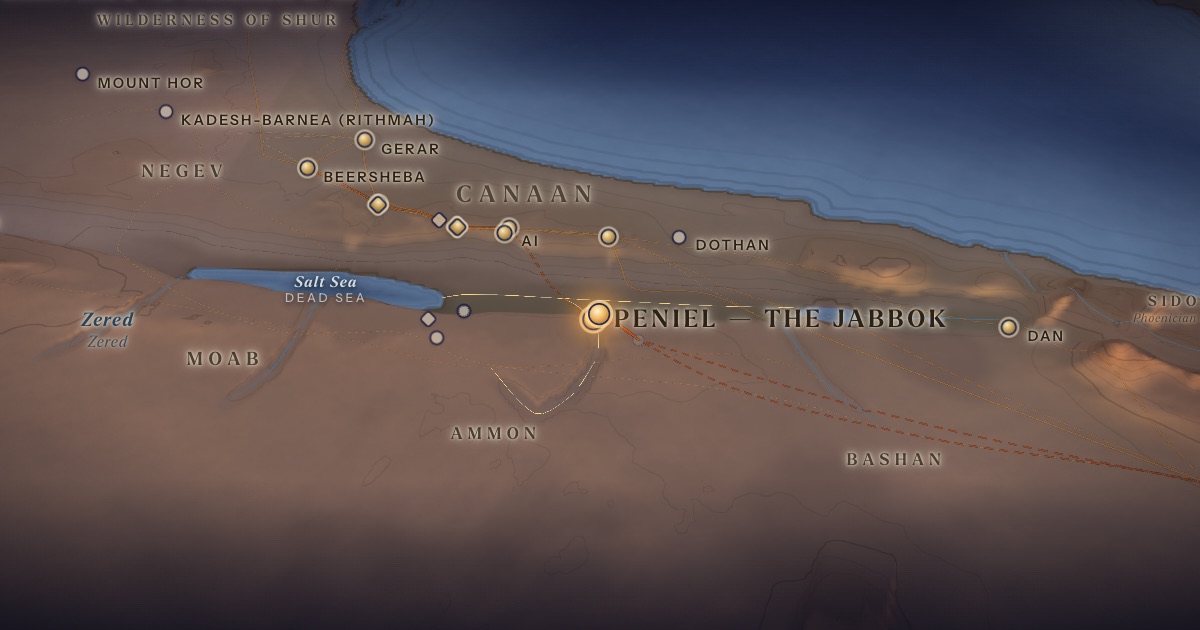
The Jabbok is the Nahr ez-Zarqa. Peniel and Mahanaim are probably the twin mounds of Tell edh-Dhahab on the river; Sukkot is probably Tell Deir ‘Alla.
- Peniel — the Jabbokפְּנִיאֵל — Tell edh-Dhahab esh-Sherqiyeh (probable)Probable identification 32.18° N, 35.67° EJacob wrestles until dawn and is named Israel.
- Sukkotסֻכּוֹת — Tell Deir ʿAlla (probable)Probable identification 32.20° N, 35.62° EJacob builds a house, and booths for his cattle.
Related sites
- Mahanaim (Tell edh-Dhahab el-Gharbi)Scholarly proposalThe western of the two Dhahab mounds; other sites have also been proposed.
The journey
Gilead → Mahanaim → Peniel≈ 20 km
Roughly 1–2 days at the pace of flocks.
Peniel → Sukkot≈ 5 km
Roughly 1 day at the pace of flocks.
Distances are estimates along plausible ancient corridors, not measured routes.
Chronology
The year Jacob leaves Laban. He then stays eighteen months at Sukkot (Rashi on Gen. 33:17).
Parsha
- Vayishlachוישלח · Genesis 32:4
Biblical Narrative
Jacob divides his camp in two (32:8–9 [Eng. 32:7–8]). “And Jacob was left alone; and there wrestled a man with him until the breaking of the day” (32:25 [Eng. 32:24]). The man touches the hollow of Jacob’s thigh and says: “Thy name shall be called no more Jacob, but Israel” (32:29 [Eng. 32:28]). Jacob limps as the sun rises. Esau runs to meet him (33:4). Jacob journeys to Sukkot and makes booths for his cattle (33:17).
Geography
The Jabbok cuts a deep, winding gorge through the Gilead highlands down to the Jordan valley — a natural barrier, and the setting for a crossing by night. Where it leaves the hills, the valley opens onto the fertile plain of Sukkot near the Jordan.
Historical Context
The Jabbok later marked boundaries — between Sihon’s Amorite kingdom and Ammon (Num. 21:24), and within Gilead. Mahanaim and Penuel reappear in the monarchic period as royal towns (2 Sam. 2:8; 1 Kgs 12:25).
Archaeology
At Tell Deir ‘Alla, Dutch excavations under H. J. Franken (from 1960) found a Late Bronze Age sanctuary and, in 1967, a plaster inscription naming “Balaam son of Beor” — the seer of Numbers 22–24. Tell edh-Dhahab el-Gharbi and esh-Sherqiyeh flank the Jabbok just upstream and are commonly proposed for Mahanaim and Penuel.
Jewish Tradition
The Torah derives the law of the “sinew of the thigh” (gid ha-nasheh), not eaten by Jews, from this night (32:33 [Eng. 32:32]). Rashi (on Gen. 32:25) identifies the wrestler as the guardian angel of Esau.
Traditional and rabbinic interpretation — presented as tradition, not as archaeological evidence.
Identification
- What the text says
- The ford of the Jabbok (32:23); Peniel/Penuel (32:31–32); Mahanaim (32:3); Sukkot (33:17).
- Scholarly proposals
- Jabbok = Nahr ez-Zarqa (identified). Penuel = Tell edh-Dhahab esh-Sherqiyeh and Mahanaim = Tell edh-Dhahab el-Gharbi (probable; alternatives exist). Sukkot = Tell Deir ‘Alla (probable).
- What remains uncertain
- The exact ford is unknown.
Sources
Hebrew Bible
- Genesis 32:2–33:17 (Eng. 32:1–33:17)בראשית ל״ב:ב׳–ל״ג:י״ז
Verse numbers follow the Hebrew (Masoretic) text. Links open the text in Hebrew and English on Sefaria.
Jewish tradition & interpretation
Interpretive tradition — not archaeological evidence.
- Rashi (R. Shlomo Yitzḥaki, 1040–1105), Commentary on the Torah. — on Gen. 32:25רש״י על בראשית ל״ב:כ״ה
Ancient & late-antique witnesses
- J. Hoftijzer and G. van der Kooij, Aramaic Texts from Deir ʿAlla (Leiden: Brill, 1976) — plaster inscription naming “Balaam son of Beor”.
Modern scholarship
- H. J. Franken, Excavations at Tell Deir ʿAllā I (Leiden: Brill, 1969).
- Nahum M. Sarna, The JPS Torah Commentary: Genesis (Philadelphia: Jewish Publication Society, 1989).
Atlases & reference works
- Burton MacDonald, “East of the Jordan”: Territories and Sites of the Hebrew Scriptures (Boston: American Schools of Oriental Research, 2000).
Translation
- The Holy Scriptures According to the Masoretic Text (Philadelphia: Jewish Publication Society of America, 1917). Source of the short quotations on each card (public domain). Verse numbers follow the Hebrew text.