
Chapter VIPatriarchal AgeאבותAbraham
חרן
Haran
“Get thee out of thy country”
1738 BCEHebrew year 2023traditionalב׳כ״ג
וַיֹּאמֶר ה׳ אֶל־אַבְרָם לֶךְ־לְךָ מֵאַרְצְךָ וּמִמּוֹלַדְתְּךָ וּמִבֵּית אָבִיךָ אֶל־הָאָרֶץ אֲשֶׁר אַרְאֶךָּ׃
“Now the LORD said unto Abram: ‘Get thee out of thy country, and from thy kindred, and from thy father’s house, unto the land that I will show thee.’”
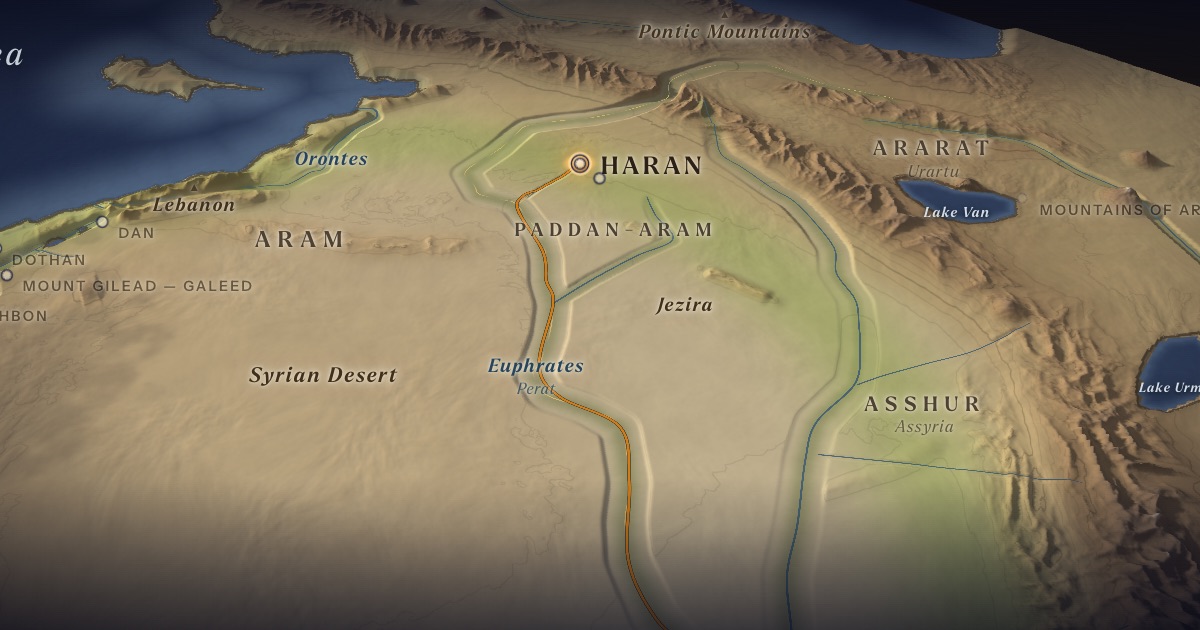
Terah’s family follows the Euphrates north-west and settles in Haran, in the Balikh valley. Terah dies there; Abram, at seventy-five, receives the call to go on to an unnamed land. Unlike Ur, Haran is securely located: the site still bears its ancient name.
Location
Harran in south-eastern Türkiye, about 40 km south-east of Şanlıurfa — a probable identification supported by the survival of the name.
- Haranחָרָן — Harran, Şanlıurfa province, TürkiyeProbable identification 36.86° N, 39.03° ETerah’s family settles here; Abram hears “Go forth.”
The journey
Ur → Haran≈ 1,100 km
Up the Euphrates and the Balikh. Roughly 55–91 days at the pace of flocks.
Distances are estimates along plausible ancient corridors, not measured routes.
Chronology
Abram leaves Haran at seventy-five (Gen. 12:4) — the Hebrew year 2023 in Seder Olam’s reckoning.
Seder Olam dates the covenant between the parts (Gen. 15) five years earlier, in 1743 BCE (Hebrew year 2018), so that the 430 years of Exod. 12:40 end at the Exodus; others read Genesis 15 in its place, after the war of the kings.
Parsha
- Lech Lechaלך לך · Genesis 12:1
Biblical Narrative
Terah dies in Haran (11:32). God tells Abram to leave “thy country… thy kindred… thy father’s house” for “the land that I will show thee,” promising to make of him a great nation (12:1–3). Abram departs with Sarai, Lot, their possessions and “the souls that they had gotten in Haran” (12:5).
Geography
Haran sits on the Balikh, a tributary of the Euphrates, where routes from Mesopotamia meet those crossing to Syria and Anatolia. Following the river from Ur is roughly 1,100 km — at the pace of flocks, some two to three months of walking, not counting halts for pasture. The route never strays far from water: rivers governed every journey in this world.
Historical Context
Harran (Akkadian Ḫarrānu, “road” or “caravan route”) appears in texts from Ebla and Mari and remained an important city into the Middle Ages; its temple of the moon-god Sin rivalled Ur’s. Several of Abraham’s kin bear names that match towns of this region in Mari and Assyrian records — Serug (Sarugi), Nahor (Naḫur), Terah (Til-Turaḫi) — suggesting the family traditions are rooted in this landscape.
Archaeology
Surveys and soundings by Seton Lloyd and William Brice (1951) and later Turkish excavations exposed the medieval city, its Great Mosque and citadel, over a mound going back to the Bronze Age. Stelae of the last Babylonian king, Nabonidus, found reused in the Great Mosque, record his restoration of the moon-temple here.
Jewish Tradition
Rashi (on Gen. 11:32, following Genesis Rabbah 39:7) notes that Terah in fact lived on for decades after Abram left; Scripture records his death first so that Abram would not be thought to have abandoned his father.
Traditional and rabbinic interpretation — presented as tradition, not as archaeological evidence.
Identification
- What the text says
- Haran (Gen. 11:31; 12:4–5; 27:43; 28:10; 29:4), in the region the text also calls Paddan-aram and Aram-naharaim.
- Traditional identification
- Tradition and scholarship agree on the region.
- Scholarly proposals
- Identified with Harran, whose name has survived in continuous use — a probable identification.
- What remains uncertain
- The extent of the settlement in the patriarchal period is not established, and the date of the patriarchs is itself debated.
Sources
Hebrew Bible
- Genesis 11:31–12:5בראשית י״א:ל״א–י״ב:ה׳
Verse numbers follow the Hebrew (Masoretic) text. Links open the text in Hebrew and English on Sefaria.
Jewish tradition & interpretation
Interpretive tradition — not archaeological evidence.
- Rashi (R. Shlomo Yitzḥaki, 1040–1105), Commentary on the Torah. — on Gen. 11:32רש״י על בראשית י״א:ל״ב
- Bereshit (Genesis) Rabbah, classical midrash on Genesis (Land of Israel, c. 5th century CE). — 39:7בראשית רבה ל״ט:ז׳
Modern scholarship
- Seton Lloyd and William Brice, “Harran,” Anatolian Studies 1 (1951): 77–111.
- Daniel E. Fleming, Democracy’s Ancient Ancestors: Mari and Early Collective Governance (Cambridge: Cambridge University Press, 2004).
- Nahum M. Sarna, The JPS Torah Commentary: Genesis (Philadelphia: Jewish Publication Society, 1989). — on 11:31–12:5
- James Henry Breasted, Ancient Times: A History of the Early World (Boston: Ginn, 1916) — coined the term “Fertile Crescent”.
Translation
- The Holy Scriptures According to the Masoretic Text (Philadelphia: Jewish Publication Society of America, 1917). Source of the short quotations on each card (public domain). Verse numbers follow the Hebrew text.