
Chapter XVIIPatriarchal AgeאבותIsaac
גרר · רחבות · שבעה
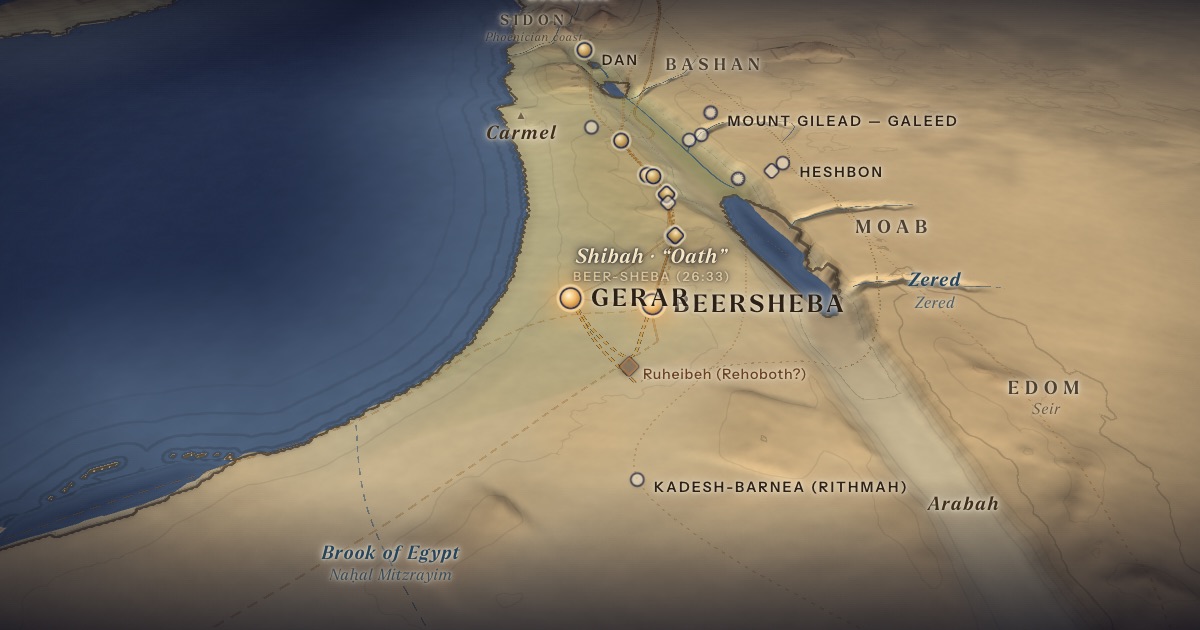
Gerar and Beersheba
The wells of Isaac
Not dated in the tradition
וַיִּקְרָא שְׁמָהּ רְחֹבוֹת וַיֹּאמֶר כִּי־עַתָּה הִרְחִיב ה׳ לָנוּ וּפָרִינוּ בָאָרֶץ׃
“And he called the name of it Rehoboth; and he said: ‘For now the LORD hath made room for us, and we shall be fruitful in the land.’”
In another famine, God tells Isaac not to go down to Egypt. He stays in Gerar, sows and reaps a hundredfold, and grows so rich that the Philistines envy him. His servants dig wells; herdsmen contest them — Esek (“contention”), Sitnah (“enmity”) — until at Rehoboth “the LORD hath made room for us.” At Beersheba he builds an altar.
Location
Gerar is usually identified with Tel Haror (Tell Abu Hureirah) on Nahal Gerar; Rehoboth is traditionally linked with Ruheibeh in the western Negev.
- Gerarגְּרָר — Tel Haror (Tell Abu Hureirah), probableProbable identification 31.38° N, 34.61° EIsaac sows and reaps a hundredfold — and quarrels over wells.
- Beershebaבְּאֵר שָׁבַע — Tel Beersheba / Bir es-SebaʿProbable identification 31.25° N, 34.84° EThe well of the oath, and a tamarisk planted.
Related sites
- Ruheibeh (Rehoboth?)TraditionByzantine Rehovot-in-the-Negev; the link rests on the name alone.
The journey
Beer-lahai-roi → Gerar≈ 50 km
Roughly 3–4 days at the pace of flocks. Route conjectural.
Gerar → Rehoboth → Beersheba≈ 70 km
Roughly 4–6 days at the pace of flocks. Route conjectural.
Distances are estimates along plausible ancient corridors, not measured routes.
Chronology
Not dated: Genesis tells it between the birth of Jacob and Esau (1653 BCE) and Esau’s marriage at forty (Gen. 26:34; 1613 BCE).
Parsha
- Toldosתולדות · Genesis 25:19
Biblical Narrative
God appears to Isaac: “Go not down into Egypt; dwell in the land” (26:2). In Gerar Isaac says Rebekah is his sister, as Abraham had done (26:7). He reopens the wells his father dug, which the Philistines had stopped, and gives them the names his father gave (26:18). After Esek and Sitnah comes Rehoboth; then Isaac goes up to Beersheba, where God appears to him and his servants find water: he names the well Shibah (26:20–33).
Geography
Gerar lies on the edge of the western Negev, where the coastal plain grades into loess steppe. In good years the loess yields heavy grain crops — hence Isaac’s “hundredfold” (26:12) — but groundwater is deep and wells are precious. Every well in the story is a claim to the land.
Historical Context
Genesis calls Abimelech “king of the Philistines” (26:1). Most historians date the Philistines’ arrival to the early 12th century BCE, so the title is generally read as the narrator using the name the region bore in his own day; some conservative scholars argue for earlier Aegean settlers.
Archaeology
Tel Haror, excavated by Eliezer Oren from 1982, was a large fortified Middle Bronze Age town with a sacred precinct, occupied again in later periods. Its identification with Gerar is probable but not certain; nearby Tel Sera‘ has also been proposed.
Jewish Tradition
Ramban (on Gen. 26:20) reads the three wells as a prophecy of the three Temples: two contested and destroyed, and a third — Rehoboth — when God will “make room” for Israel in peace.
Traditional and rabbinic interpretation — presented as tradition, not as archaeological evidence.
Identification
- What the text says
- Gerar and “the valley of Gerar” (26:1, 6, 17); the wells Esek, Sitnah, Rehoboth and Shibah (26:20–33).
- Traditional identification
- Rehoboth has been associated with Ruheibeh (Byzantine Rehovot-in-the-Negev) because of the name.
- Scholarly proposals
- Gerar = Tel Haror is the most common proposal.
- What remains uncertain
- The individual wells cannot be located.
Sources
Hebrew Bible
- Genesis 26:1–33בראשית כ״ו:א׳–ל״ג
Verse numbers follow the Hebrew (Masoretic) text. Links open the text in Hebrew and English on Sefaria.
Jewish tradition & interpretation
Interpretive tradition — not archaeological evidence.
- Ramban (Naḥmanides, R. Moshe ben Naḥman, 1194–1270), Commentary on the Torah. — on Gen. 26:20רמב״ן על בראשית כ״ו:כ׳
Modern scholarship
- Nahum M. Sarna, The JPS Torah Commentary: Genesis (Philadelphia: Jewish Publication Society, 1989).
- Israel Finkelstein and Neil Asher Silberman, The Bible Unearthed: Archaeology’s New Vision of Ancient Israel and the Origin of Its Sacred Texts (New York: Free Press, 2001).
- Kenneth A. Kitchen, On the Reliability of the Old Testament (Grand Rapids: Eerdmans, 2003).
Atlases & reference works
- Ephraim Stern (ed.), The New Encyclopedia of Archaeological Excavations in the Holy Land, 4 vols. (Jerusalem: Israel Exploration Society & Carta, 1993); vol. 5 (2008). — s.v. “Haror, Tel”
Translation
- The Holy Scriptures According to the Masoretic Text (Philadelphia: Jewish Publication Society of America, 1917). Source of the short quotations on each card (public domain). Verse numbers follow the Hebrew text.