
Chapter XXVIIIEgyptמצריםJoseph
שבר במצרים
Grain from Egypt
The brothers go down
1523 BCEHebrew year 2238traditionalב׳רל״ח
אֲנִי יוֹסֵף אֲחִיכֶם אֲשֶׁר־מְכַרְתֶּם אֹתִי מִצְרָיְמָה׃
“I am Joseph your brother, whom ye sold into Egypt.”
The famine reaches Canaan. Ten brothers go down to Egypt for grain and bow before the governor, not recognising Joseph. He tests them, holds Simeon, and demands Benjamin. On a second journey Joseph hides his cup in Benjamin’s sack; when Judah offers himself in Benjamin’s place, Joseph reveals himself: “I am Joseph your brother.”
Location
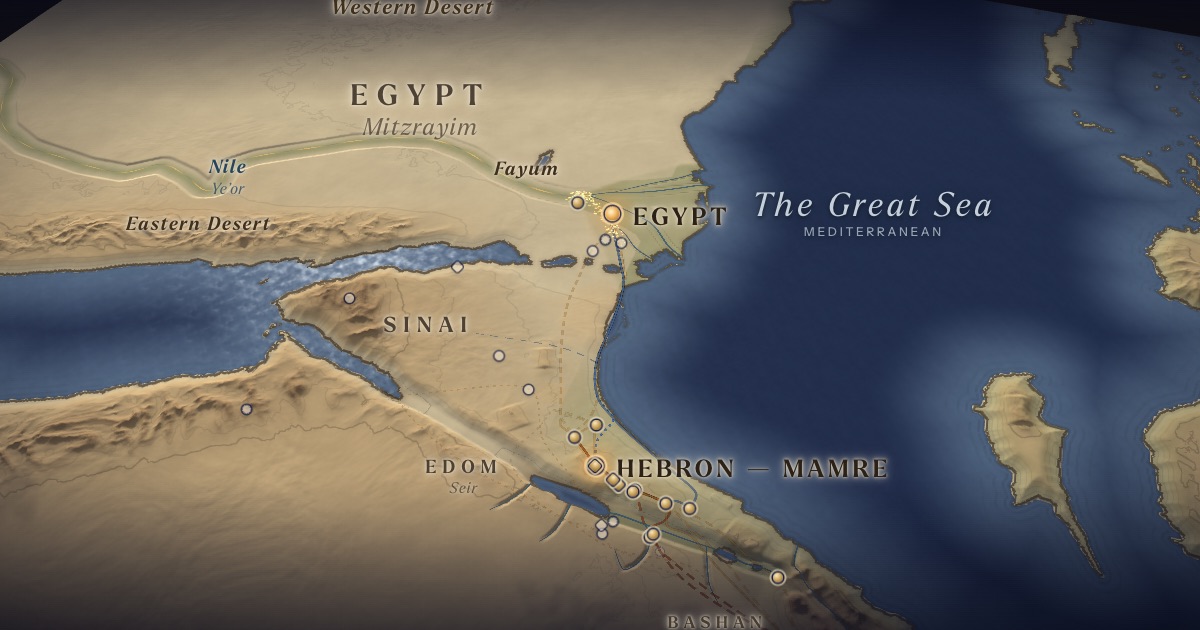
Between Hebron and Egypt — two round trips of roughly 700 km each.
- Egyptמִצְרַיִם — Nile Valley and DeltaTextually identified 30.55° N, 31.35° EThe land of the Nile — refuge in famine, and later bondage.
- Hebron — Mamreחֶבְרוֹן — Tel Rumeida, HebronProbable identification 31.52° N, 35.10° EAbraham settles by the terebinths of Mamre.
The journey
The brothers’ journeys≈ 350 km
The coastal road — twice there and back. Roughly 11–15 days at caravan pace.
Distances are estimates along plausible ancient corridors, not measured routes.
Chronology
Joseph makes himself known in the second year of the famine (Gen. 45:6); the brothers’ first journey comes shortly before.
Parsha
- Mikeitzמקץ · Genesis 41:1
Biblical Narrative
“Ye are spies,” Joseph accuses them (42:9). Among themselves they admit their guilt over Joseph (42:21). Jacob refuses to send Benjamin until the grain runs out (43:1–14). At the second meeting, after the cup is found, Judah pleads for Benjamin (44:18–34). Joseph weeps aloud and sends wagons to bring Jacob (45:1–28).
Geography
Hebron to the eastern Delta is roughly 350 km each way by the coastal road. With laden donkeys at perhaps 25–30 km a day, each round trip took about a month. “Going down” to Egypt and “going up” to Canaan are literal: the route descends from the hills of Judah to the flat Delta.
Historical Context
Egyptian administration of grain storage is richly documented — tomb models of granaries, and officials titled “overseer of the granaries” — though no text refers to Joseph.
Jewish Tradition
Rashi (on Gen. 45:27) says the wagons (agalot) were a private sign to Jacob, recalling the law of the heifer (eglah arufah) they had last studied together — proof that the message truly came from Joseph.
Traditional and rabbinic interpretation — presented as tradition, not as archaeological evidence.
Identification
- What the text says
- Egypt and the land of Canaan (42:1–5, 29).
- Scholarly proposals
- The regions are certain.
- What remains uncertain
- The governor’s city is unnamed.
Sources
Hebrew Bible
- Genesis 42:1–45:28בראשית מ״ב:א׳–מ״ה:כ״ח
Verse numbers follow the Hebrew (Masoretic) text. Links open the text in Hebrew and English on Sefaria.
Jewish tradition & interpretation
Interpretive tradition — not archaeological evidence.
- Rashi (R. Shlomo Yitzḥaki, 1040–1105), Commentary on the Torah. — on Gen. 45:27רש״י על בראשית מ״ה:כ״ז
Modern scholarship
- Donald B. Redford, A Study of the Biblical Story of Joseph (Genesis 37–50), VTSup 20 (Leiden: Brill, 1970).
- Nahum M. Sarna, The JPS Torah Commentary: Genesis (Philadelphia: Jewish Publication Society, 1989).
Translation
- The Holy Scriptures According to the Masoretic Text (Philadelphia: Jewish Publication Society of America, 1917). Source of the short quotations on each card (public domain). Verse numbers follow the Hebrew text.