
Chapter IVPrimeval HistoryראשיתBabel
מגדל בבל
The Tower of Babel
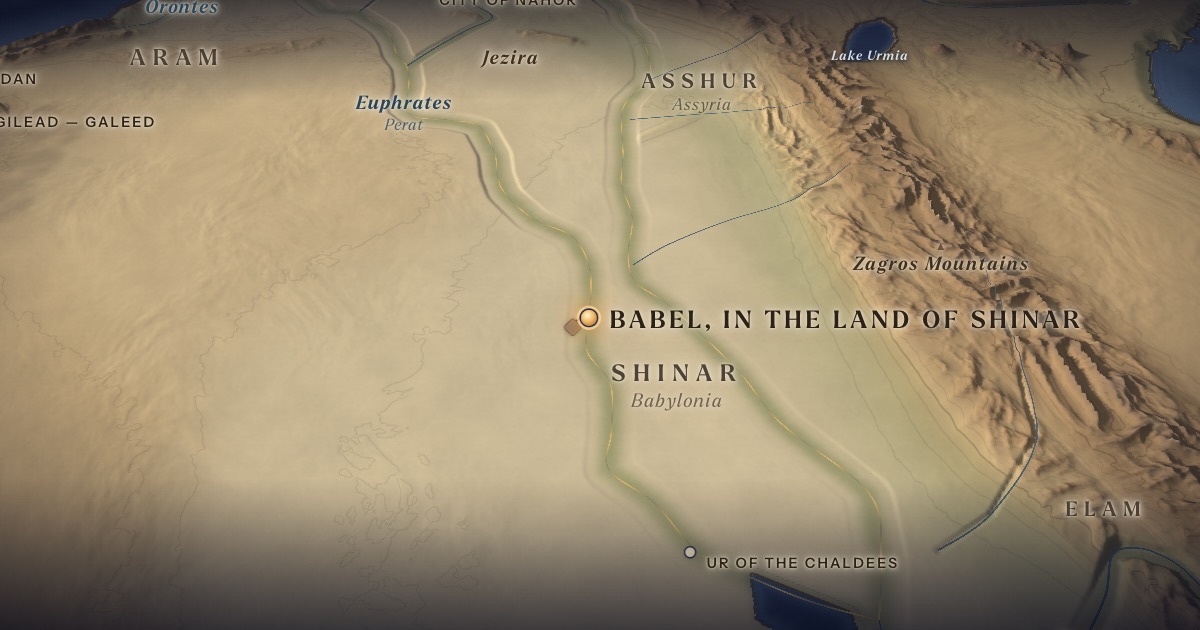
A city in the land of Shinar
1765 BCEHebrew year 1996traditionalא׳תתקצ״ו
עַל־כֵּן קָרָא שְׁמָהּ בָּבֶל כִּי־שָׁם בָּלַל ה׳ שְׂפַת כָּל־הָאָרֶץ
“Therefore was the name of it called Babel; because the LORD did there confound the language of all the earth.”
Humanity, speaking one language, settles in the plain of Shinar and builds with baked brick and bitumen — the building materials of Mesopotamia. Genesis names the city Babel: Babylon. The setting is unusually concrete, and the tower has long been compared with Babylon’s great ziggurat, Etemenanki.
Location
Shinar is Babylonia (compare Gen. 10:10), and Babel is Babylon, whose ruins lie near Hillah in Iraq. A link between the story and Etemenanki is a scholarly comparison, not an identification.
- Babel, in the land of Shinarבָּבֶל — Babylon, near Hillah, IraqProbable identification 32.54° N, 44.42° EA city and a tower “with its top in heaven.”
Related sites
- Etemenanki, BabylonScholarly proposalThe ziggurat of Babylon; only its foundations survive.
- Borsippa (Birs Nimrud)Tradition · Some medieval and early-modern travellersIts ruined ziggurat was often pointed out to travellers as the Tower of Babel.
Chronology
Seder Olam places the dispersion in the Hebrew year 1996, at the end of Peleg’s life.
Abram is then forty-eight.
Biblical Narrative
The whole earth has one language. People journeying miqedem — “from the east” — find a plain in the land of Shinar and say, “Come, let us make brick… let us build us a city, and a tower, with its top in heaven” (11:3–4). God confounds their language and scatters them; the city is called Babel, which the text connects with balal, “to confuse” (11:9).
Geography
Southern Mesopotamia has almost no building stone or timber, so its cities were built of mud brick — kiln-fired for important buildings — often bonded with bitumen from seeps such as those near Hit on the Euphrates. Genesis notes exactly this contrast with Canaan: “brick for stone, and slime [bitumen] for mortar” (11:3).
Historical Context
Babylon’s ziggurat Etemenanki, “House, Foundation of Heaven and Earth,” was rebuilt on a vast scale by Nebuchadnezzar II in the 6th century BCE and described by Herodotus in the 5th. Its Babylonian name, Bāb-ili, meant “gate of the god(s)”; the Hebrew wordplay with “confusion” deliberately reads the name against its grain.
Archaeology
Robert Koldewey’s excavations (1899–1917) exposed the square base of Etemenanki, about 91 m on each side; almost nothing of the superstructure survives. Cuneiform tablets record its dimensions and its rebuilding.
Jewish Tradition
Genesis 10 attributes Babel to the kingdom of Nimrod (10:8–10). Rabbinic tradition calls the builders the “generation of the dispersion” (dor ha-pelagah) and dates the event to the end of Peleg’s life (Seder Olam 1; compare Gen. 10:25, “in his days was the earth divided”).
Traditional and rabbinic interpretation — presented as tradition, not as archaeological evidence.
Identification
- What the text says
- The land of Shinar (11:2), where Babel, Erech (Uruk) and Akkad lay (10:10) — southern Mesopotamia. The city is Babel (11:9), the Hebrew name of Babylon.
- Traditional identification
- Jewish tradition locates the tower at Babylon, as the text does.
- Scholarly proposals
- Many scholars read the story as a Judean reflection on Babylon and its ziggurat, sharpened by the Babylonian exile; others argue for older roots. The comparison with Etemenanki is widely discussed (George 2005/6).
- What remains uncertain
- Whether the story preserves memory of a particular tower, and of which period, cannot be determined.
Sources
Hebrew Bible
- Genesis 11:1–9בראשית י״א:א׳–ט׳
- Genesis 10:8–12בראשית י׳:ח׳–י״ב
Verse numbers follow the Hebrew (Masoretic) text. Links open the text in Hebrew and English on Sefaria.
Jewish tradition & interpretation
Interpretive tradition — not archaeological evidence.
Ancient & late-antique witnesses
- Herodotus, Histories 1.181 (5th century BCE) — description of the temple tower of Babylon.
Modern scholarship
- A. R. George, “The Tower of Babel: Archaeology, History and Cuneiform Texts,” Archiv für Orientforschung 51 (2005/2006): 75–95.
- Nahum M. Sarna, The JPS Torah Commentary: Genesis (Philadelphia: Jewish Publication Society, 1989). — on 11:1–9
- E. A. Speiser, Genesis, Anchor Bible 1 (Garden City, NY: Doubleday, 1964).
Translation
- The Holy Scriptures According to the Masoretic Text (Philadelphia: Jewish Publication Society of America, 1917). Source of the short quotations on each card (public domain). Verse numbers follow the Hebrew text.