
Chapter XXXIIIEgyptמצריםMoses
ארץ מדין
Flight to Midian
A stranger in a strange land
Not dated in the tradition
וַיִּבְרַח מֹשֶׁה מִפְּנֵי פַרְעֹה וַיֵּשֶׁב בְּאֶרֶץ־מִדְיָן וַיֵּשֶׁב עַל־הַבְּאֵר׃
“But Moses fled from the face of Pharaoh, and dwelt in the land of Midian; and he sat down by a well.”
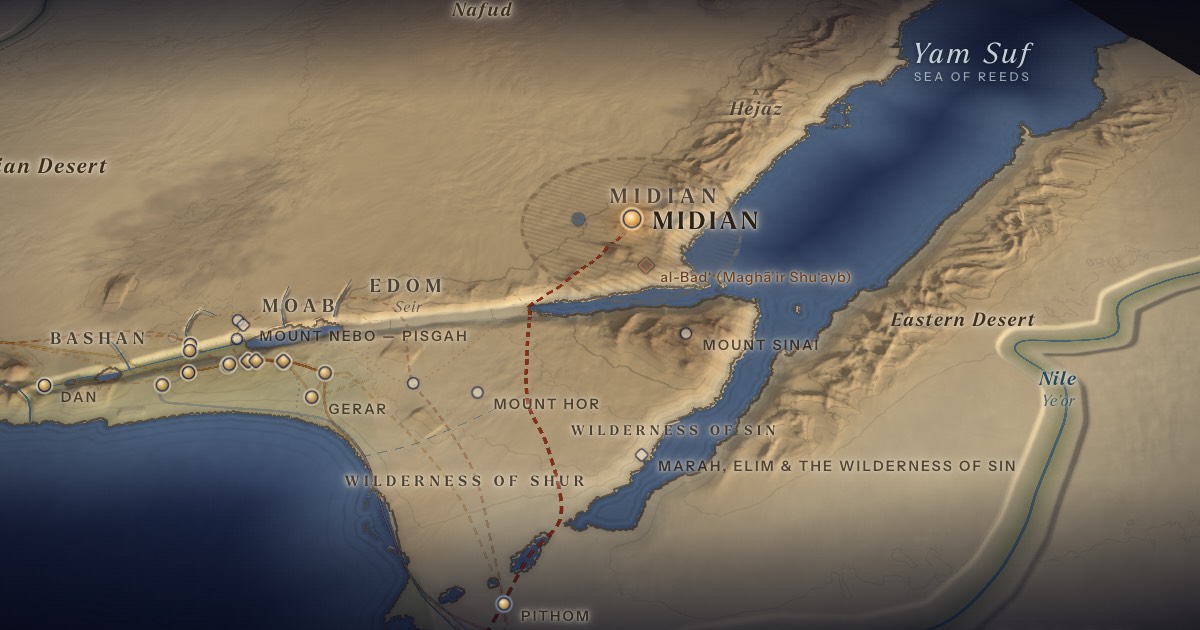
Moses flees across Sinai to Midian. At a well he defends the seven daughters of a priest — Reuel, also called Jethro — against shepherds and waters their flock. He marries Zipporah and names his son Gershom: “I have been a stranger in a strange land.”
Location
Midian is placed in north-western Arabia, east of the Gulf of Aqaba, where the great oasis of Qurayyah flourished. The site of Jethro’s encampment is unknown.
- Midianמִדְיָן — North-western Arabia (Hejaz)Probable identification 28.35° N, 35.75° EMoses sits down by a well and finds a home.
Related sites
- QurayyahScholarly proposalGreat walled oasis; source of the painted “Midianite” (Qurayyah) ware.
- al-Bad‘ (ancient Madyan)Scholarly proposal · Josephus; Ptolemy; EusebiusThe oasis town that kept the name Madyan — Ptolemy’s Modiana — near the Gulf of Aqaba, with Nabataean rock-cut tombs.
The journey
Egypt → Midian≈ 500 km
Across central Sinai toward the Gulf of Aqaba. Roughly 15–21 days on foot. Route conjectural.
Distances are estimates along plausible ancient corridors, not measured routes.
Chronology
The midrash differs on Moses’ age when he fled — twenty, or forty (Shemot Rabbah) — so the tradition gives no single year. He is at the bush in 1314 BCE.
Biblical Narrative
Reuel’s daughters report that “an Egyptian delivered us out of the hand of the shepherds” (2:19). Moses marries Zipporah (2:21). “In the course of those many days” the king of Egypt dies; Israel cries out, and “God remembered His covenant” (2:23–24).
Geography
From the eastern Delta to the head of the Gulf of Aqaba is about 400 km across the limestone plateau of central Sinai — the line of the later pilgrims’ road, the Darb el-Hajj. Beyond the gulf rise the granite mountains of the Hejaz: a land of oases and seasonal pasture, where wells are meeting places — as in the stories of Rebekah, Rachel and now Zipporah.
Historical Context
Midianites appear in the Bible as camel-riding traders and nomads (Gen. 37:28; Judg. 6–8). Some scholars — the “Midianite” or “Kenite hypothesis” — suggest that the worship of Israel’s God had roots in this southern region, pointing to texts in which God “came from Seir… from mount Paran” (Deut. 33:2; compare Judg. 5:4; Hab. 3:3) and to Moses’ Midianite father-in-law. It is a debated scholarly hypothesis, not a traditional view. Classical writers knew a town of the same name: Josephus calls it Madiane, Ptolemy’s Geography marks Modiana on the Arabian shore, and Eusebius’ Onomasticon lists Madiam in the desert east of the gulf — the oasis later called Madyan, at al-Bad‘.
Archaeology
Qurayyah, north-west of Tabuk, was a vast walled oasis with irrigation works, occupied from the late 4th millennium BCE. Its distinctive painted pottery — long called “Midianite” ware — has been found at Timna and other Aravah sites of the late 2nd millennium BCE. At Timna, Beno Rothenberg found a small Egyptian mining shrine converted into a tent sanctuary, with this pottery and a copper snake with a gilded head. At al-Bad‘, the oasis identified with ancient Madyan, the Nabataeans later cut a row of tombs into the sandstone cliffs, as at Hegra and Petra.
Jewish Tradition
Rashi (on Exod. 2:16) relates that Jethro had renounced idolatry and was shunned by his people — which is why shepherds harassed his daughters. Jewish tradition honours Jethro as a model convert, and the Torah portion containing the Ten Commandments bears his name, Yitro.
Traditional and rabbinic interpretation — presented as tradition, not as archaeological evidence.
Identification
- What the text says
- “The land of Midian” (2:15); its priest, Reuel/Jethro (2:18; 3:1).
- Traditional identification
- Josephus places Moses’ Midian at the city of Madiane, near the sea (Antiquities 2.257); no Jewish tradition fixes the well.
- Scholarly proposals
- Most scholars place Midian in north-western Arabia (the Hejaz), with Qurayyah as a major centre; Midianites also ranged into Sinai, the Negev and Transjordan.
- What remains uncertain
- Jethro’s home and the well cannot be identified.
Sources
Hebrew Bible
- Exodus 2:15–25שמות ב׳:ט״ו–כ״ה
Verse numbers follow the Hebrew (Masoretic) text. Links open the text in Hebrew and English on Sefaria.
Jewish tradition & interpretation
Interpretive tradition — not archaeological evidence.
- Rashi (R. Shlomo Yitzḥaki, 1040–1105), Commentary on the Torah. — on Exod. 2:16רש״י על שמות ב׳:ט״ז
Ancient & late-antique witnesses
- Flavius Josephus, Jewish Antiquities (c. 93–94 CE), Loeb Classical Library (Harvard University Press). — 2.257
- Eusebius of Caesarea, Onomasticon (early 4th century CE); ed. and trans. R. Steven Notley and Ze’ev Safrai (Leiden: Brill, 2005).
Modern scholarship
- Marta Luciani and Abdullah S. Alsaud, “The New Archaeological Joint Project on the Site of Qurayyah, North-West Arabia: Results of the First Two Excavation Seasons,” Proceedings of the Seminar for Arabian Studies 48 (2018).
- Beno Rothenberg, Timna: Valley of the Biblical Copper Mines (London: Thames & Hudson, 1972).
- Joseph Blenkinsopp, “The Midianite-Kenite Hypothesis Revisited and the Origins of Judah,” Journal for the Study of the Old Testament 33 (2008): 131–153.
- Nahum M. Sarna, The JPS Torah Commentary: Exodus (Philadelphia: Jewish Publication Society, 1991).
Translation
- The Holy Scriptures According to the Masoretic Text (Philadelphia: Jewish Publication Society of America, 1917). Source of the short quotations on each card (public domain). Verse numbers follow the Hebrew text.