
Chapter XVIPatriarchal AgeאבותIsaac
ארם נהרים
A Bride from Aram-naharaim
The servant’s journey
1673 BCEHebrew year 2088traditionalב׳פ״ח
וַיָּקָם וַיֵּלֶךְ אֶל־אֲרַם נַהֲרַיִם אֶל־עִיר נָחוֹר׃
“and he arose, and went to Aram-naharaim, unto the city of Nahor.”
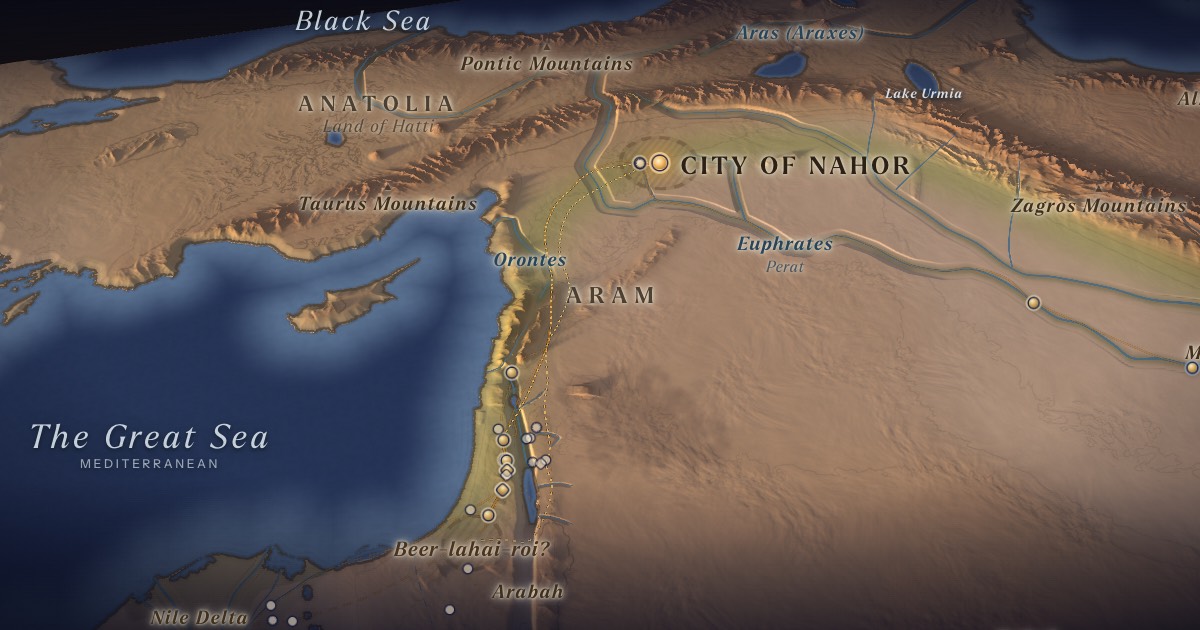
Abraham sends his senior servant back to his kin to find a wife for Isaac. With ten camels the servant travels to Aram-naharaim, “the city of Nahor,” and prays at the well at evening. Rebekah comes out, waters his camels and agrees to go with him. Isaac, walking in the field at dusk near Beer-lahai-roi, sees the camels coming.
Location
“The city of Nahor” lay in Aram-naharaim, the region of Haran; its site is unknown. Beer-lahai-roi is in the Negev, location unknown.
- City of Nahorעִיר נָחוֹר — Aram-naharaim, near Haran — site unknownDisputed 36.80° N, 39.40° ERebekah is found at the well outside the city.
- Beer-lahai-roiבְּאֵר לַחַי רֹאִי — “Between Kadesh and Bered” — unknownUnknown 30.95° N, 34.55° EThe well of the Living One who sees me.
The journey
The servant → Aram-naharaim≈ 900 km
The caravan road through Syria. Roughly 26–36 days at caravan pace. Route conjectural.
Return with Rebekah≈ 950 km
Perhaps by the King’s Highway. Roughly 28–39 days at caravan pace. Route conjectural.
Distances are estimates along plausible ancient corridors, not measured routes.
Chronology
Isaac is forty when he marries Rebekah (Gen. 25:20).
Parsha
- Chayei Sarahחיי שרה · Genesis 23:1
Biblical Narrative
The servant asks for a sign: the young woman who offers water to him and to his camels will be the one (24:12–14). Rebekah, granddaughter of Nahor, does exactly that (24:15–20). Her brother Laban welcomes the servant, and Rebekah says, “I will go” (24:58). Isaac, dwelling in the Negev near Beer-lahai-roi, meets her in the field; she becomes his wife, “and he loved her” (24:62–67).
Geography
A round trip between the Negev and the Haran region is well over 1,500 km. Ten camels could water only at substantial wells — and Rebekah’s offer to water them all was no small act: a thirsty camel can drink a hundred litres or more.
Historical Context
Scholars debate when domestic camels were used for caravans in the Levant. Animal-bone evidence from the Aravah copper mines suggests they were introduced there around the 10th century BCE, and many take the camels of Genesis as a detail from the narrator’s own time; others point to earlier, sporadic evidence.
Archaeology
A town called Nahur is known from the Mari archives (18th century BCE) in the upper Habur–Balikh region; its site has not been identified.
Jewish Tradition
Tradition identifies the unnamed servant with Eliezer of Damascus (Gen. 15:2). The Midrash marks his swift journey as miraculous — “the earth leapt toward him” (Rashi on Gen. 24:42, following Sanhedrin 95a).
Traditional and rabbinic interpretation — presented as tradition, not as archaeological evidence.
Identification
- What the text says
- “Aram-naharaim, unto the city of Nahor” (24:10) — “Aram of the two rivers,” the land between the Euphrates and the Habur, around Haran.
- Traditional identification
- Tradition equates the servant with Eliezer (15:2), though Genesis 24 does not name him.
- Scholarly proposals
- Nahur is attested in Mari texts in the same region, but its site is unknown.
- What remains uncertain
- The city of Nahor cannot be located; Beer-lahai-roi (“between Kadesh and Bered,” 16:14) is also unknown.
Sources
Hebrew Bible
- Genesis 24:1–67בראשית כ״ד:א׳–ס״ז
Verse numbers follow the Hebrew (Masoretic) text. Links open the text in Hebrew and English on Sefaria.
Jewish tradition & interpretation
Interpretive tradition — not archaeological evidence.
- Rashi (R. Shlomo Yitzḥaki, 1040–1105), Commentary on the Torah. — on Gen. 24:42רש״י על בראשית כ״ד:מ״ב
- Babylonian Talmud (Talmud Bavli), redacted c. 6th century CE. — Sanhedrin 95aבבלי סנהדרין צ״ה א
Modern scholarship
- Daniel E. Fleming, Democracy’s Ancient Ancestors: Mari and Early Collective Governance (Cambridge: Cambridge University Press, 2004).
- Lidar Sapir-Hen and Erez Ben-Yosef, “The Introduction of Domestic Camels to the Southern Levant: Evidence from the Aravah Valley,” Tel Aviv 40 (2013): 277–285.
- Nahum M. Sarna, The JPS Torah Commentary: Genesis (Philadelphia: Jewish Publication Society, 1989). — on ch. 24
Translation
- The Holy Scriptures According to the Masoretic Text (Philadelphia: Jewish Publication Society of America, 1917). Source of the short quotations on each card (public domain). Verse numbers follow the Hebrew text.