
Chapter VPatriarchal AgeאבותAbraham
אור כשדים
Ur of the Chaldees
Abraham’s world before Canaan
1813 BCEHebrew year 1948traditionalא׳תתקמ״ח
וַיֵּצְאוּ אִתָּם מֵאוּר כַּשְׂדִּים לָלֶכֶת אַרְצָה כְּנַעַן וַיָּבֹאוּ עַד־חָרָן וַיֵּשְׁבוּ שָׁם׃
“and they went forth with them from Ur of the Chaldees, to go into the land of Canaan; and they came unto Haran, and dwelt there.”
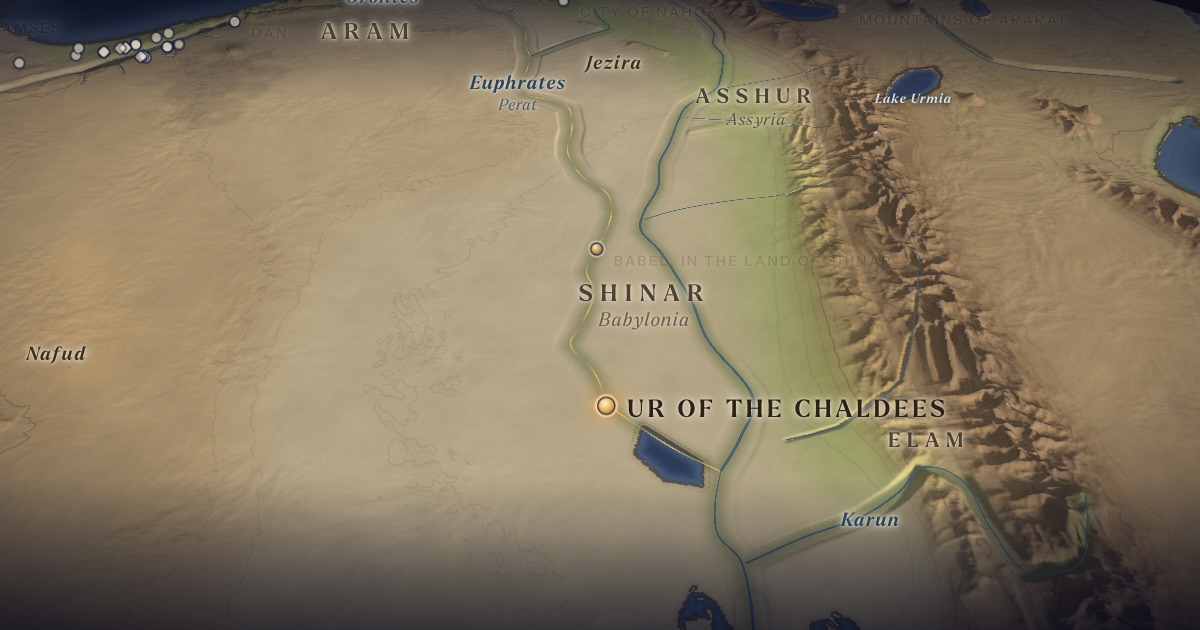
According to Genesis, Abram’s family came from “Ur Kasdim” — Ur of the Chaldees — before Terah led them toward Canaan. Since Leonard Woolley’s excavations in the 1920s, Ur has usually been identified with Tell el-Muqayyar in southern Iraq, one of the great cities of Sumer. The identification is widely held but not certain; other candidates lie far to the north.
Location
Most often identified with Tell el-Muqayyar in southern Iraq; a northern Mesopotamian location has also been argued. The text does not describe the site.
- Ur of the Chaldeesאוּר כַּשְׂדִּים — Tell el-Muqayyar, Iraq (most common identification)Disputed 30.96° N, 46.10° EWhere Abraham’s family begins its journey.
Proposed locations
- Tell el-MuqayyarScholarly proposal · Majority view since C. L. WoolleyThe Sumerian city of Ur, with its ziggurat and Royal Cemetery.
- Şanlıurfa (Edessa)Tradition · Popular Jewish and Christian traditionAbout 40 km north-west of Haran; revered as Abraham’s birthplace.
Chronology
Seder Olam: Abram is born in the Hebrew year 1948 (traditionally 1813 BCE). Scholarly datings of the patriarchs vary widely — from the early 2nd millennium BCE to the view that the narratives are literary works of the 1st millennium.
Biblical Narrative
Terah fathers Abram, Nahor and Haran; Haran dies “in the land of his nativity, in Ur of the Chaldees” (11:28). Terah then takes Abram, Sarai and his grandson Lot and sets out “to go into the land of Canaan” — but they stop at Haran and settle there (11:31). Later God tells Abram: “I am the LORD that brought thee out of Ur of the Chaldees” (15:7).
Geography
Southern Ur stood beside an ancient course of the Euphrates, close to the marshes at the head of the Persian Gulf. From here the practical way to Canaan runs not west across the Arabian desert but north-west up the Euphrates, then south through Syria — the great arc of the Fertile Crescent. The straight line to Canaan is about 1,000 km; the walkable route through Haran is nearly twice as long.
Historical Context
Ur was a major Sumerian city for more than two thousand years; under its Third Dynasty (c. 2112–2004 BCE) it ruled much of Mesopotamia. Ur’s moon-god, Nanna (Akkadian Sin), was also the great god of Haran — one of several links scholars have noted between the two stages of Terah’s journey. The phrase “of the Chaldees” (Kasdim) is itself a clue: the Chaldeans appear in Mesopotamian records only from the 9th century BCE, so most scholars take it as a later narrator’s description.
Archaeology
Woolley’s excavations (1922–1934), for the British Museum and the University of Pennsylvania, uncovered the ziggurat of Ur-Nammu, residential quarters and the famous Royal Cemetery. Nothing found there refers to Abraham, and archaeology cannot confirm that biblical Ur is this site.
Jewish Tradition
The Midrash reads “Ur Kasdim” as “the fire of the Chaldeans” (ur = fire) and tells how Abram survived Nimrod’s furnace for rejecting idols (Genesis Rabbah 38:13; Rashi on Gen. 11:28). A long-standing tradition, cherished today in Şanlıurfa in south-eastern Türkiye, places Abraham’s birthplace there, close to Haran.
Traditional and rabbinic interpretation — presented as tradition, not as archaeological evidence.
Identification
- What the text says
- “Ur of the Chaldees” (Gen. 11:28, 31; 15:7; Neh. 9:7) — a name, with no geographical description.
- Traditional identification
- Midrash interprets “Ur” as “fire.” A popular Jewish and Christian tradition identifies Ur with Şanlıurfa (ancient Edessa), near Haran.
- Scholarly proposals
- The majority view identifies Ur with Tell el-Muqayyar in southern Iraq (Woolley). Cyrus Gordon and others argued for a northern “Ura” nearer Haran, which would shorten the journey dramatically.
- What remains uncertain
- The identification remains debated. The route on the map follows the majority (southern) view.
Sources
Hebrew Bible
- Genesis 11:26–32בראשית י״א:כ״ו–ל״ב
- Genesis 15:7בראשית ט״ו:ז׳
- Nehemiah 9:7נחמיה ט׳:ז׳
Verse numbers follow the Hebrew (Masoretic) text. Links open the text in Hebrew and English on Sefaria.
Jewish tradition & interpretation
Interpretive tradition — not archaeological evidence.
- Bereshit (Genesis) Rabbah, classical midrash on Genesis (Land of Israel, c. 5th century CE). — 38:13בראשית רבה ל״ח:י״ג
- Rashi (R. Shlomo Yitzḥaki, 1040–1105), Commentary on the Torah. — on Gen. 11:28רש״י על בראשית י״א:כ״ח
Modern scholarship
- C. Leonard Woolley, Ur ‘of the Chaldees’: The Final Account, rev. P. R. S. Moorey (Ithaca: Cornell University Press, 1982).
- Ur Online — digital archive of the Ur excavations (Penn Museum and the British Museum).
- Cyrus H. Gordon, “Abraham and the Merchants of Ura,” Journal of Near Eastern Studies 17 (1958): 28–31.
- Nahum M. Sarna, The JPS Torah Commentary: Genesis (Philadelphia: Jewish Publication Society, 1989). — on 11:28–31
Atlases & reference works
- Michael D. Coogan (ed.), The Oxford History of the Biblical World (New York: Oxford University Press, 1998).
Translation
- The Holy Scriptures According to the Masoretic Text (Philadelphia: Jewish Publication Society of America, 1917). Source of the short quotations on each card (public domain). Verse numbers follow the Hebrew text.