
Chapter XXXIIEgyptמצריםMoses
משה
Moses on the Nile
Drawn from the water
7 Adar · 1393 BCEHebrew year 2368traditionalז׳ אדר ב׳שס״ח
וַתִּקְרָא שְׁמוֹ מֹשֶׁה וַתֹּאמֶר כִּי מִן־הַמַּיִם מְשִׁיתִהוּ׃
“And she called his name Moses, and said: ‘Because I drew him out of the water.’”
A Levite woman hides her son for three months, then places him in an ark of bulrushes among the reeds (suf) of the Nile. Pharaoh’s daughter finds him, pities him, and raises him as her son. Grown, Moses sees an Egyptian beating a Hebrew and kills him. When the deed becomes known, he flees.
Location
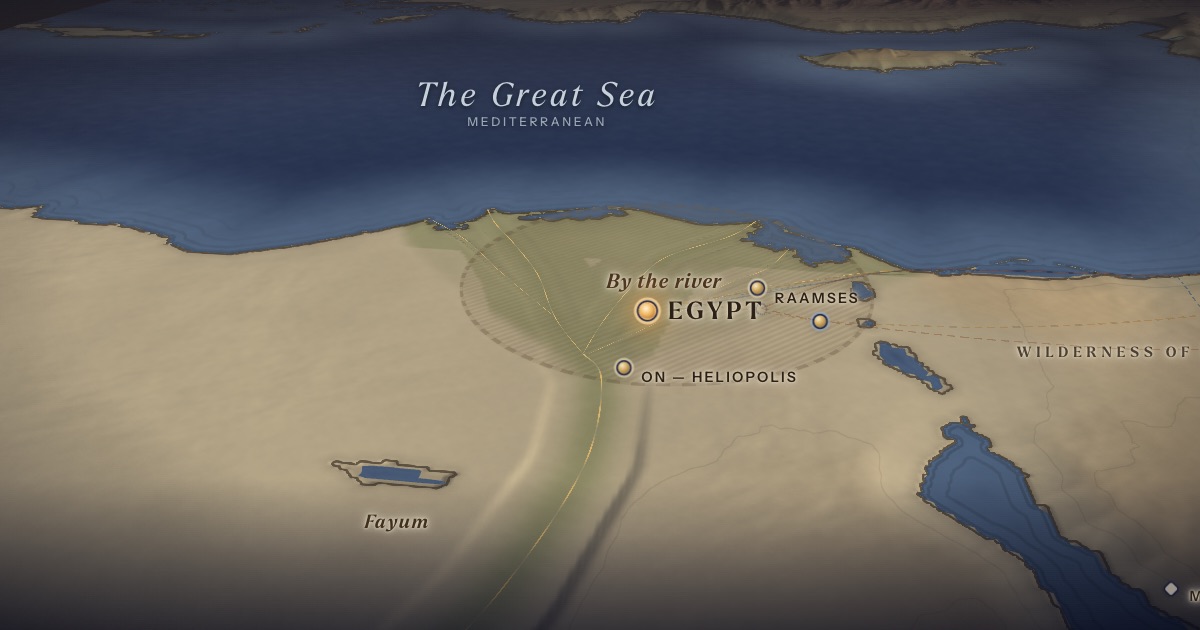
Egypt, by the Nile; no place is named, and later local traditions cannot be verified.
- Egyptמִצְרַיִם — Nile Valley and DeltaTextually identified 30.55° N, 31.35° EThe land of the Nile — refuge in famine, and later bondage.
Chronology
Seder Olam: Moses is born in the Hebrew year 2368.
On 7 Adar — the day he will die (Megillah 13b).
Biblical Narrative
Miriam watches from a distance and arranges for Moses’ own mother to nurse him (2:4–9). Moses “went out unto his brethren, and looked on their burdens” (2:11). The next day two Hebrews quarrel: “Who made thee a ruler and a judge over us?” (2:14). Pharaoh seeks to kill him, and Moses flees (2:15).
Geography
The “reeds” (suf) where the basket is hidden are the same word as in Yam Suf — the sea Israel will later cross. Papyrus thickets lined the Delta’s channels and marshes.
Historical Context
The name Moses is often compared with Egyptian mose/mes, “born of” or “child,” as in Thutmose and Ramesses; the Bible explains it through Hebrew mashah, “to draw out” (2:10). The motif of an infant set adrift and raised in a royal household also appears in the Legend of Sargon of Akkad, known from 1st-millennium BCE copies.
Archaeology
No evidence of Moses has been found outside the Bible — unsurprising for an individual of this kind, and neither confirming nor refuting the story.
Jewish Tradition
The Midrash (Exodus Rabbah 1:26) tells how the child Moses reached for Pharaoh’s crown and was tested with gold and a burning coal; an angel guided his hand to the coal, which he put to his mouth — explaining why he was “slow of speech” (4:10).
Traditional and rabbinic interpretation — presented as tradition, not as archaeological evidence.
Identification
- What the text says
- “The river” — the Nile (2:3, 5); no city is named.
- Traditional identification
- Various local traditions, none early.
- Scholarly proposals
- A Delta setting near a royal residence is often assumed.
- What remains uncertain
- Unknown.
Sources
Hebrew Bible
- Exodus 2:1–15שמות ב׳:א׳–ט״ו
Verse numbers follow the Hebrew (Masoretic) text. Links open the text in Hebrew and English on Sefaria.
Jewish tradition & interpretation
Interpretive tradition — not archaeological evidence.
Modern scholarship
- Nahum M. Sarna, The JPS Torah Commentary: Exodus (Philadelphia: Jewish Publication Society, 1991). — on 2:1–10
- Donald B. Redford, Egypt, Canaan, and Israel in Ancient Times (Princeton: Princeton University Press, 1992).
- James K. Hoffmeier, Israel in Egypt: The Evidence for the Authenticity of the Exodus Tradition (New York: Oxford University Press, 1997).
Translation
- The Holy Scriptures According to the Masoretic Text (Philadelphia: Jewish Publication Society of America, 1917). Source of the short quotations on each card (public domain). Verse numbers follow the Hebrew text.