
Chapter XIPatriarchal AgeאבותAbraham
חברון · ממרא
Hebron — the Oaks of Mamre
Walk through the land
1676 BCEHebrew year 2085traditionalב׳פ״ה
קוּם הִתְהַלֵּךְ בָּאָרֶץ לְאָרְכָּהּ וּלְרָחְבָּהּ כִּי לְךָ אֶתְּנֶנָּה׃
“Arise, walk through the land in the length of it and in the breadth of it; for unto thee will I give it.”
After Lot departs, God tells Abram to look north, south, east and west: all the land he sees is promised. Abram moves his tent to the terebinths of Mamre at Hebron. Hebron becomes the patriarchs’ home: here Abraham welcomes three visitors, and here he buys the Cave of Machpelah to bury Sarah.
Location
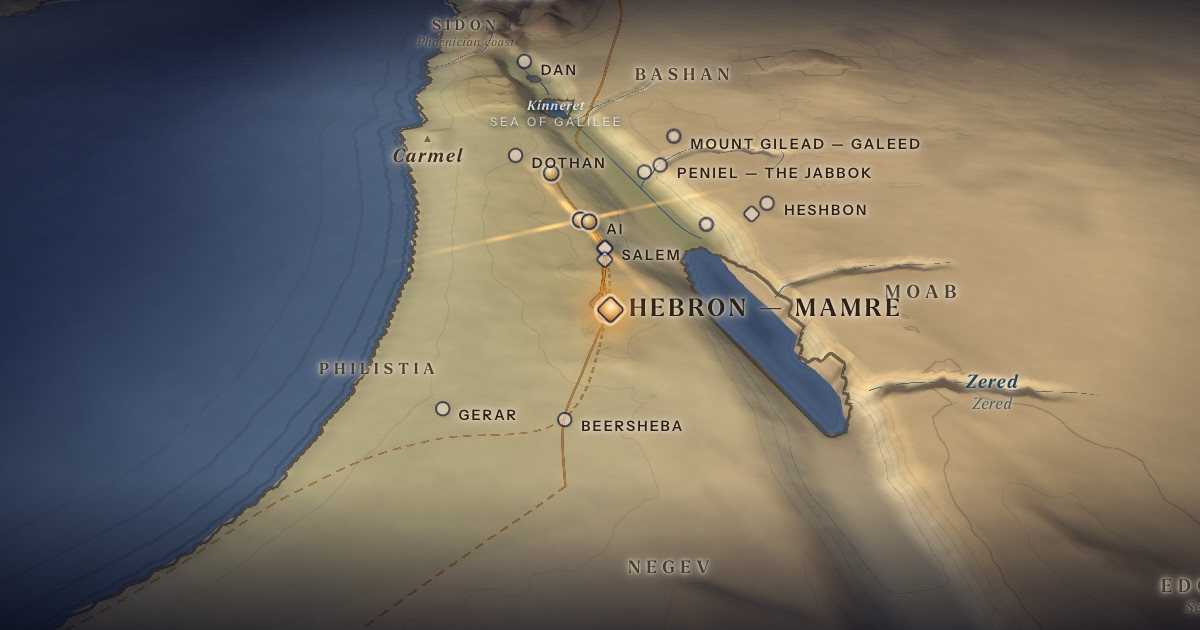
Ancient Hebron is Tel Rumeida, within the modern city of Hebron. Mamre and the Cave of Machpelah are located by long tradition.
- Hebron — Mamreחֶבְרוֹן — Tel Rumeida, HebronProbable identification 31.52° N, 35.10° EAbraham settles by the terebinths of Mamre.
- Cave of Machpelahמְעָרַת הַמַּכְפֵּלָה — Tomb of the Patriarchs, Hebron (Herodian enclosure)Traditional identification 31.52° N, 35.11° EBurial place of the patriarchs and matriarchs, by tradition.
Related sites
- Ramat el-Khalil (Mamre)TraditionHerodian enclosure and Constantinian basilica marking the traditional oak of Mamre.
The journey
Bethel → Hebron≈ 45 km
South along the ridge road. Roughly 2–4 days at the pace of flocks.
Distances are estimates along plausible ancient corridors, not measured routes.
Chronology
Sarah dies at 127 (Gen. 23:1).
The three visitors come earlier, in 1714 BCE (Hebrew year 2047), when Abraham is ninety-nine (Gen. 17:24, 18:1).
Biblical Narrative
Abram settles “by the terebinths of Mamre, which are in Hebron,” and builds an altar (13:18). At Mamre he receives three guests who announce Isaac’s birth (18:1–15). When Sarah dies at Kiriath-arba — “the same is Hebron” — Abraham buys the field and cave of Machpelah from Ephron the Hittite for four hundred shekels of silver: the first land in Canaan his family owns (23:2–20).
Geography
Hebron lies about 930 m up in the southern hill country — among the highest towns in the land — where the ridge road begins its descent toward Beersheba and the Negev. Its valleys were known for vineyards; the spies’ famous cluster of grapes comes from nearby Eshcol (Num. 13:22–24).
Historical Context
Numbers 13:22 notes that Hebron “was built seven years before Zoan in Egypt” — a rare biblical synchronism with Egyptian history. Hebron was a fortified town in the Middle Bronze Age.
Archaeology
Excavations at Tel Rumeida exposed Middle Bronze Age city walls and later Iron Age remains. The monumental enclosure over the Cave of Machpelah was built in the Herodian period (1st century BCE); the caves beneath have not been excavated. At Ramat el-Khalil, north of Hebron, a Herodian enclosure — later the site of a Constantinian basilica — marked the traditional Mamre.
Jewish Tradition
Jewish tradition holds that four couples are buried in Machpelah — Adam and Eve, Abraham and Sarah, Isaac and Rebekah, Jacob and Leah — reading “Kiriath-arba” (“city of four”) accordingly (Rashi on Gen. 23:2; Genesis Rabbah 58:4).
Traditional and rabbinic interpretation — presented as tradition, not as archaeological evidence.
Identification
- What the text says
- “The terebinths of Mamre, which are in Hebron” (13:18); Machpelah “before Mamre — the same is Hebron” (23:19).
- Traditional identification
- The Tomb of the Patriarchs has been venerated by Jews for some two thousand years — though from 1267 to 1967 the Mamluk and Ottoman rulers barred Jews from entering, allowing them to climb only to the seventh step outside; Mamre is traditionally at Ramat el-Khalil.
- Scholarly proposals
- Tel Rumeida as ancient Hebron is a probable identification.
- What remains uncertain
- The identification of the burial cave rests on tradition, not excavation.
Sources
Hebrew Bible
- Genesis 13:14–18בראשית י״ג:י״ד–י״ח
- Genesis 18:1–15בראשית י״ח:א׳–ט״ו
- Genesis 23:1–20בראשית כ״ג:א׳–כ׳
Verse numbers follow the Hebrew (Masoretic) text. Links open the text in Hebrew and English on Sefaria.
Jewish tradition & interpretation
Interpretive tradition — not archaeological evidence.
- Rashi (R. Shlomo Yitzḥaki, 1040–1105), Commentary on the Torah. — on Gen. 23:2רש״י על בראשית כ״ג:ב׳
- Bereshit (Genesis) Rabbah, classical midrash on Genesis (Land of Israel, c. 5th century CE). — 58:4בראשית רבה נ״ח:ד׳
Modern scholarship
- Nahum M. Sarna, The JPS Torah Commentary: Genesis (Philadelphia: Jewish Publication Society, 1989).
Atlases & reference works
- Ephraim Stern (ed.), The New Encyclopedia of Archaeological Excavations in the Holy Land, 4 vols. (Jerusalem: Israel Exploration Society & Carta, 1993); vol. 5 (2008). — s.v. “Hebron”; “Mamre”
- Anson F. Rainey and R. Steven Notley, The Sacred Bridge: Carta’s Atlas of the Biblical World (Jerusalem: Carta, 2006).
Translation
- The Holy Scriptures According to the Masoretic Text (Philadelphia: Jewish Publication Society of America, 1917). Source of the short quotations on each card (public domain). Verse numbers follow the Hebrew text.